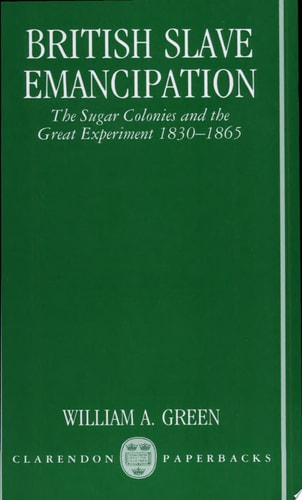
British Slave Emancipation: The Sugar Colonies and the Great Experiment 1830-1865
0
0
As an Amazon Associate and affiliate partner, Menrva Books earns from qualifying purchases. Learn more
Author Description
A study of the West Indies in the mid-nineteenth century, this book draws together the experiences of more than a dozen different sugar colonies and forms them into a coherent historical account. The first part of the book examines the West Indies on the eve of emancipation in 1830-1865, a key passage in West Indian history. Green presents a clear general picture of the sugar colonies, and places British governmental policy toward the region in the context of Victorian attitudes toward colonial questions.
Menrva's Summary
THE THESIS
This work investigates the complex socio-economic and political transition of the British West Indies following the abolition of slavery between 1830 and 1865. William A. Green, a noted historian of the British Empire, utilizes extensive archival records and colonial administrative data to analyze the collapse of the plantation system. He argues that the emancipation process was not a singular event but a prolonged, multifaceted experiment that fundamentally reshaped Victorian colonial policy and the economic structure of the sugar colonies.
THE SCOPE MAP
What You Will Find
- A comparative analysis of over a dozen distinct sugar-producing colonies in the West Indies.
- An examination of British governmental policy and its alignment with Victorian-era colonial ideologies.
- Primary source evidence derived from colonial office records and contemporary administrative reports.
- A detailed study of the economic transition from slave labor to alternative labor systems in the mid-nineteenth century.
THE AUTHORITY PERSPECTIVE
Historians frequently cite this text as a foundational resource for understanding the structural shifts in the British Caribbean during the post-emancipation era. The prose is noted for its academic rigor and its ability to synthesize disparate colonial experiences into a cohesive historical narrative.
Page Count:
464
Publication Date:
1991-10-10
Publisher:
Clarendon Press
ISBN-10:
0198202784
ISBN-13:
9780198202783
History
Economics
British History
Colonialism
West Indies
Slavery
Great Britain
Caribbean History