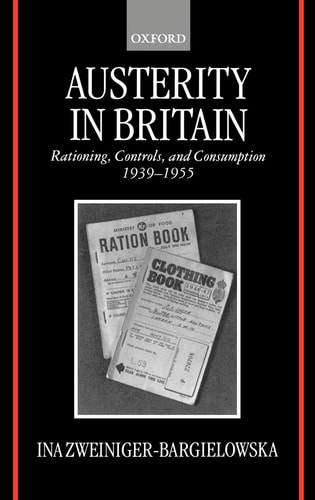
Austerity in Britain: Rationing, Controls, and Consumption, 1939-1955
0
0
As an Amazon Associate and affiliate partner, Menrva Books earns from qualifying purchases. Learn more
Author Description
Austerity in Britain is the first book to explore the entire episode of rationing, austerity, and fair shares from 1939 until 1955. These policies were central to the British war effort and to post-war reconstruction. The book analyzes the connections between government policy, consumption, gender, and party politics during and after the Second World War. It qualifies the myth of common sacrifice on the home front and highlights the limitations of the fairshares policy which failed to achieve genuine equality between classes or between men and women. The continuation of rationing and austerity policies after 1945 was central to party politics. Disaffection, particularly among women, undermined Labour's popularity while the Conservatives' critique of austerity was instrumental to the party's victories at the general elections of 1951 and 1955.
Menrva's Summary
THE THESIS
This book investigates the socio-economic impact of rationing and austerity policies in Britain from 1939 to 1955, questioning the extent to which these measures achieved their stated goal of social equality. Ina Zweiniger-Bargielowska, a historian specializing in 20th-century British social and political history, utilizes government archives and contemporary records to examine the intersection of state control, consumption patterns, and gender dynamics. The work argues that the 'fair shares' policy was fundamentally limited, failing to bridge class divides or address gender-based inequalities, and ultimately served as a pivotal factor in the political shifts of the post-war era.
THE SCOPE MAP
What You Will Find
- A comprehensive analysis of British rationing and consumption policies spanning the Second World War and the subsequent reconstruction period.
- Examination of the political influence of austerity on the Labour and Conservative parties during the 1951 and 1955 general elections.
- Evidence derived from government policy documents, social surveys, and contemporary political discourse.
- A critical evaluation of the 'common sacrifice' narrative and its role in shaping post-war British identity.
THE AUTHORITY PERSPECTIVE
Historians and scholars of British social policy recognize this work as a definitive study on the domestic realities of the post-war era. Readers frequently note the academic density of the prose and the author's meticulous use of primary sources to challenge established historical myths.
Page Count:
304
Publication Date:
2000-06-01
Publisher:
Oxford University Press
ISBN-10:
0198204531
ISBN-13:
9780198204534
Economics
History
Social History
Great Britain
British History