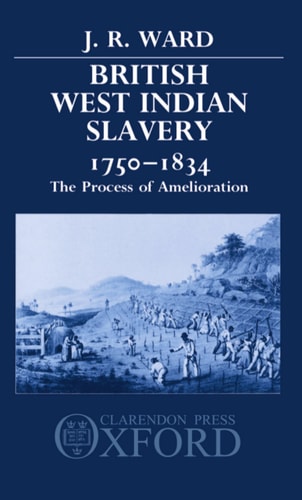
British West Indian Slavery, 1750-1834: The Process of Amelioration
0
0
As an Amazon Associate and affiliate partner, Menrva Books earns from qualifying purchases. Learn more
Author Description
The first account of Caribbean slavery to draw from the plantation records of several different sugar colonies, this book examines the attempts made by British West Indian planters to improve the treatment of their slaves, partly in response to the anti-slavery movement. Ward argues that although the measures taken did raise the standard of living and productive efficiency of plantation slaves, "amelioration" contained serious weaknesses that made it ultimately ineffective as a means of defending the institution of slavery. Though focused on the British West Indies, the book's main theme--the potential for reform and economic development in slave-based societies--will hold wider significance for a variety of economic and social historians.
Menrva's Summary
THE THESIS
This book investigates the efficacy and limitations of the 'amelioration' policies implemented by British West Indian planters to reform the treatment of enslaved people between 1750 and 1834. J. R. Ward, a noted historian of the Caribbean, utilizes extensive plantation records from multiple sugar colonies to analyze the intersection of humanitarian pressure and economic management. The author argues that while these reforms improved certain living conditions and increased productive efficiency, they were fundamentally insufficient to sustain the institution of slavery against growing abolitionist sentiment.
THE SCOPE MAP
What You Will Find
- Analysis of primary plantation records from various British sugar colonies.
- Evaluation of the economic impact of reform measures on slave-based production.
- Examination of the political and social pressures exerted by the anti-slavery movement.
- Assessment of the structural weaknesses inherent in the amelioration process.
THE AUTHORITY PERSPECTIVE
Historians recognize this work as a foundational study for its rigorous use of empirical plantation data to challenge previous assumptions about slave management. Scholars frequently cite the text for its balanced approach to the complex relationship between economic development and humanitarian reform in colonial societies.
Page Count:
336
Publication Date:
1988-09-15
Publisher:
Clarendon Press
ISBN-10:
0198201443
ISBN-13:
9780198201441
History
Caribbean History
Social History
Slavery
Economic History
British Empire
Community Tags
Similar Books