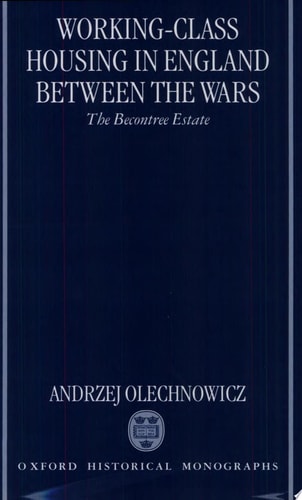
Working-Class Housing in England between the Wars: The Becontree Estate
0
0
As an Amazon Associate and affiliate partner, Menrva Books earns from qualifying purchases. Learn more
Author Description
Built between 1921 and 1934, the London County Council's Becontree Estate was the largest public housing scheme ever undertaken in Britain, and, at the time of its planning, in the world. Using interviews with surviving tenants from the inter-year period, Dr Olechnowicz discusses the early years of the estate, looking in detail at the philosophy behind its construction and management, and showing how it eventually came to be denigrated as a social concentration camp.
Menrva's Summary
THE THESIS
This study investigates the socio-political motivations and subsequent lived realities of the Becontree Estate, the largest public housing project in interwar Britain. Dr. Andrzej Olechnowicz, a historian specializing in British social history, utilizes archival records and primary source interviews with original tenants to evaluate the gap between the London County Council's utopian planning goals and the eventual social stigmatization of the estate. The work argues that the failure of the project to meet its lofty social objectives was rooted in both top-down management philosophies and the economic constraints of the era.
THE SCOPE MAP
What You Will Find
- Detailed analysis of the London County Council's public housing policies between 1921 and 1934.
- Examination of the architectural and urban planning philosophies that defined the Becontree Estate.
- Primary source evidence derived from interviews with original tenants who inhabited the estate during the interwar period.
- A critical assessment of how the estate transitioned from a model of social progress to a site of perceived social isolation.
THE AUTHORITY PERSPECTIVE
Experts recognize this monograph as a definitive academic account of interwar British urban development and social policy. Readers frequently note the scholarly density of the prose, which provides a rigorous examination of the intersection between state-led housing initiatives and the lived experiences of the working class.
Page Count:
288
Publication Date:
1997-03-27
Publisher:
Clarendon Press
ISBN-10:
019820650X
ISBN-13:
9780198206507
Architecture
History
British History
Great Britain
Public Policy
Social History
urban planning