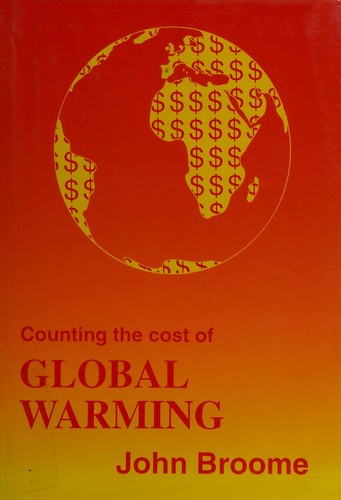
Counting the Cost of Global Warming
0
0
As an Amazon Associate and affiliate partner, Menrva Books earns from qualifying purchases. Learn more
Author Description
Since the last ice age, when ice enveloped most of the northern continents, the earth has warmed up by about five degrees. Within a century, it is likely to warm by another four or five, because of the greenhouse gases that we are dumping into the atmosphere. This will have immense and mostly harmful effects on the lives of people not yet born. How much should the present generation be prepared to pay to mitigate these harmful effects? How much should we sacrifice for the sake of the future? In Counting the Cost of Global Warming, John Broome surveys the ways in which economists and philosophers have tackled the question of our responsibility to future generations, with special reference to the economic and ethical issues raised by the threat of global warming. His conclusions on the extent to which we are entitled to 'discount' the long term future make essential reading for economists, philosophers and social scientists who are concerned with policy in this vital area.
Menrva's Summary
THE THESIS
The present generation faces an immense ethical and economic dilemma concerning the mitigation of global warming's harmful effects on future generations. John Broome, a noted economist and philosopher, examines how economists and philosophers have approached the question of intergenerational responsibility, specifically in the context of climate change. The book delves into the economic and ethical considerations of sacrificing present resources for the benefit of those not yet born. Broome's analysis critically assesses the concept of 'discounting' the future, offering essential insights for policymakers and academics concerned with this critical issue.
THE SCOPE MAP
- Analysis of economic and philosophical approaches to intergenerational responsibility.
- Examination of the ethical issues raised by global warming.
- Discussion on the extent to which future benefits can be 'discounted'.
- Focus on the economic implications of climate change mitigation policies.
- Targeted at economists, philosophers, and social scientists involved in policy-making.
THE AUTHORITY PERSPECTIVE
John Broome's 'Counting the Cost of Global Warming' is recognized for its rigorous examination of the economic and ethical dimensions of climate change policy. The book is particularly noted for its in-depth analysis of intergenerational equity and the complex question of discounting future harms. Scholars and policymakers in economics, philosophy, and social sciences find its conclusions essential for understanding and formulating responses to global warming. The work is considered a significant contribution to the discourse on our responsibilities to future generations in the face of environmental challenges.
Page Count:
147
Publication Date:
1992-01-01
ISBN-10:
1874267014
Economics
Philosophy
Non-Fiction
Art
Climate Change
Ethics
Community Tags
Similar Books