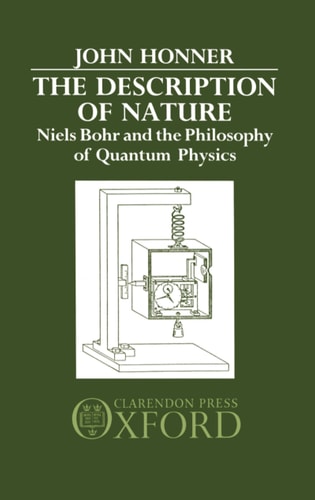
The Description of Nature: Niels Bohr and the Philosophy of Quantum Physics
0
0
As an Amazon Associate and affiliate partner, Menrva Books earns from qualifying purchases. Learn more
Author Description
Niels Bohr, founding father of modern atomic physics and quantum theory, was as original a philosopher as he was a physicist. This study explores several dimensions of Bohr's vision: the formulation of quantum theory and the problems associated with its interpretation, the notions of complementarity and correspondence, the debates with Einstein about objectivity and realism, and his sense of the infinite harmony of nature. Honner focuses on Bohr's epistemological lesson, the conviction that all our description of nature is dependent on the words we use and the ways we can unambiguously use them.
Menrva's Summary
THE THESIS
How does the philosophical framework of Niels Bohr redefine our understanding of physical reality and the limits of scientific description? John Honner, a scholar of the history and philosophy of science, examines the intellectual evolution of Niels Bohr, the architect of modern atomic theory. The book synthesizes Bohr's technical contributions to quantum mechanics with his broader epistemological concerns, arguing that the act of observation is inextricably linked to the linguistic and conceptual tools employed by the observer. By analyzing Bohr's correspondence and public debates, Honner constructs a portrait of a thinker who viewed the harmony of nature as a challenge to traditional notions of objective realism.
THE SCOPE MAP
What You Will Find
- An analysis of the complementarity principle and its role in resolving quantum paradoxes.
- A detailed account of the historical debates between Niels Bohr and Albert Einstein regarding the nature of reality.
- An exploration of Bohr's epistemological conviction that scientific language shapes the boundaries of physical knowledge.
- A thematic investigation into the intersection of atomic physics and classical philosophical inquiry.
THE AUTHORITY PERSPECTIVE
Scholars and physicists frequently cite this work as a vital resource for understanding the philosophical underpinnings of the Copenhagen interpretation. Readers often note the academic density of the prose, which requires a foundational familiarity with both quantum theory and philosophical terminology to fully appreciate the author's arguments.
Page Count:
248
Publication Date:
1988-04-14
Publisher:
Clarendon Press
ISBN-10:
0198249764
ISBN-13:
9780198249764
Biography
Science
Philosophy
Physics
Community Tags
Similar Books