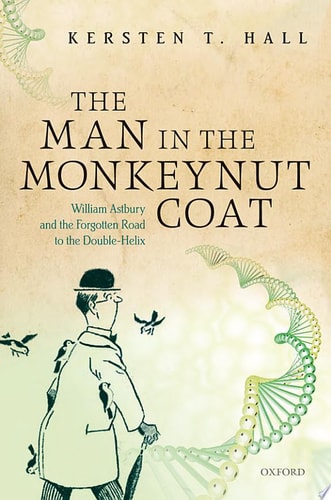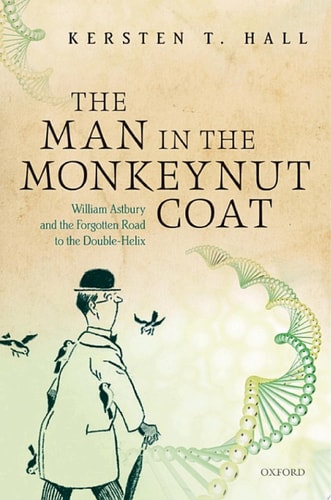
The Man in the Monkeynut Coat: William Astbury and How Wool Wove a Forgotten Road to the Double-Helix
0
0
As an Amazon Associate and affiliate partner, Menrva Books earns from qualifying purchases. Learn more
Author Description
Sir Isaac Newton once declared that his momentous discoveries were only made thanks to having 'stood on the shoulders of giants'. The same might also be said of the scientists James Watson and Francis Crick. Their discovery of the structure of DNA was, without doubt, one of the biggest scientific landmarks in history and, thanks largely to the success of Watson's best-selling memoir 'The Double Helix', there might seem to be little new to say about this story. But much remains to be said about the particular 'giants' on whose shoulders Watson and Crick stood. Of these, the crystallographer Rosalind Franklin, whose famous X-ray diffraction photograph known as 'Photo 51' provided Watson and Crick with a vital clue, is now well recognised. Far less well known is the physicist William T. Astbury who, working at Leeds in the 1930s on the structure of wool for the local textile industry, pioneered the use of X-ray crystallography to study biological fibres. In so doing, he not only made the very first studies of the structure of DNA culminating in a photo almost identical to Franklin's 'Photo 51', but also founded the new science of 'molecular biology'. Yet whilst Watson and Crick won the Nobel Prize, Astbury has largely been forgotten. The Man in the Monkeynut Coat tells the story of this neglected pioneer, showing not only how it was thanks to him that Watson and Crick were not left empty-handed, but also how his ideas transformed biology leaving a legacy which is still felt today.
Menrva's Summary
THE THESIS
This book investigates the historical oversight of William T. Astbury, a physicist whose pioneering work in X-ray crystallography laid the foundation for molecular biology and the discovery of DNA's structure. Kersten T. Hall, a historian of science, utilizes archival research and scientific records to reconstruct Astbury's career at the University of Leeds. The author argues that Astbury's early studies on biological fibers, specifically wool, provided the essential methodology and preliminary data that enabled later breakthroughs by Watson and Crick. By situating Astbury within the context of the 1930s textile industry and the burgeoning field of biophysics, Hall demonstrates how his contributions were instrumental yet largely eclipsed in the popular narrative of the double helix.
THE SCOPE MAP
What You Will Find
- Detailed account of 1930s X-ray crystallography applications in the textile industry.
- Analysis of the transition from classical physics to the birth of molecular biology.
- Biographical examination of William T. Astbury's academic and professional life.
Scope Limits
- The text does not provide a comprehensive biography of every scientist involved in the DNA discovery.
- It does not offer a technical manual for modern X-ray diffraction techniques.
THE AUTHORITY PERSPECTIVE
Historians of science frequently cite this work as a corrective to the narrow focus of popular DNA discovery narratives. Experts highlight the book's success in balancing technical scientific history with an accessible biographical account of a neglected figure.
Page Count:
255
Publication Date:
2014-01-01
Publisher:
OUP Oxford
ISBN-10:
019100989X
ISBN-13:
9780191009891
History
Biography
Earth Sciences
Physiology
Physics
Dna
Physicists
Science History
Community Tags
Similar Books