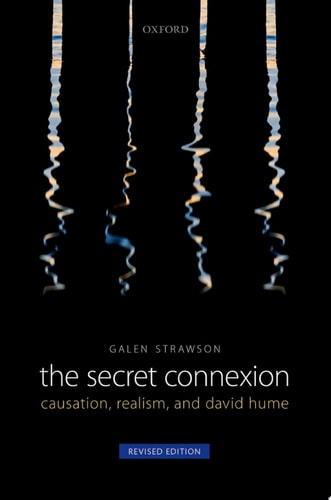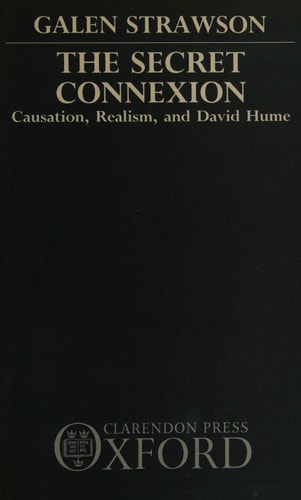
The Secret Connexion: Causation, Realism, and David Hume
0
0
As an Amazon Associate and affiliate partner, Menrva Books earns from qualifying purchases. Learn more
Author Description
It is widely supposed that David Hume invented and espoused the "regularity" theory of causation, holding that causal relations are nothing but a matter of one type of thing being regularly followed by another. It is also widely supposed that he was not only right about this, but that it was one of his greatest contributions to philosophy. Strawson here argues that the regularity theory of causation is indefensible, and that Hume never adopted it in any case. Strawson maintains that Hume did not claim that causation in the natural world is just a matter of regular succession, that such a dogmatic metaphysical claim about the nature of reality would have been utterly contrary to his fundamental philosophical principles, and that he rightly took it for granted that there was more to causation than regularity of succession, claiming only that regularity of succession was all that we could ever know of causation.
Menrva's Summary
THE THESIS
This book investigates the core question of whether David Hume truly held a regularity theory of causation or if his philosophical principles suggest a more nuanced, realist perspective. Galen Strawson, a prominent philosopher, utilizes a rigorous textual analysis of Hume’s primary works to challenge the long-standing academic consensus. He argues that attributing a dogmatic regularity theory to Hume is a misinterpretation that contradicts the philosopher's fundamental skepticism and metaphysical caution.
THE SCOPE MAP
What You Will Find
- A detailed re-examination of Hume’s writings on causal relations and natural necessity.
- A critique of the standard regularity theory of causation as an indefensible philosophical position.
- An analysis of the distinction between what can be known about causation versus the actual nature of reality.
- A historical argument regarding the evolution of Humean scholarship and its potential errors.
THE AUTHORITY PERSPECTIVE
Experts in the field of early modern philosophy frequently cite this text as a significant intervention in Humean studies that forces a reconsideration of established interpretations. Readers often note the high level of academic density and the meticulous nature of Strawson's argumentation throughout the work.
Page Count:
312
Publication Date:
1989-10-12
Publisher:
Oxford University Press
ISBN-10:
0198248539
ISBN-13:
9780198248538
Philosophy
Epistemology
Metaphysics
Causation