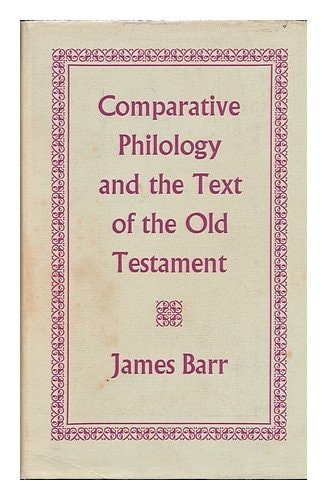
Comparative Philology and the Text of the Old Testament
0
0
As an Amazon Associate and affiliate partner, Menrva Books earns from qualifying purchases. Learn more
Author Description
This book applies, in a more specialist area, a similar treatment to that used by Professor Barr in The Semantics of Biblical Language, and like the earlier volume criticizes much of previous scholarship. In recent Old Testament studies, increasing reliance has been placed on the resources of languages other than Hebrew itself -Arabic, Aramaic, Accadian and Ugaritic. Scholars have used these languages as a source from which the meaning of unusual Hebrew words might be deduced. Professor Barr discusses the principles involved in this process. He considers such questions as the degree of coincidence in the vocabularies of cognate languages, the extent of homonymy in Hebrew, the history of the transmission of meanings in Hebrew and the value of the ancient translations.
Menrva's Summary
THE THESIS
This book investigates the methodological validity of using cognate Semitic languages to determine the meaning of obscure Hebrew vocabulary within the Old Testament. Professor James Barr, a noted scholar in biblical linguistics, critiques the prevailing reliance on comparative philology, arguing that scholars often overextend the utility of languages like Arabic, Aramaic, and Ugaritic. He provides a rigorous framework for evaluating how meanings are transmitted and how homonymy affects the interpretation of ancient texts.
THE SCOPE MAP
What You Will Find
- Analysis of comparative philological methods in Old Testament scholarship
- Examination of vocabulary overlap between Hebrew and cognate languages
- Discussion on the history and transmission of semantic meaning
- Evaluation of the reliability of ancient translations as interpretive tools
THE AUTHORITY PERSPECTIVE
Experts recognize this work as a critical, cautionary text that challenges established interpretive practices in biblical studies. Scholars frequently cite Barr's analysis for its academic rigor and its significant influence on the methodology of modern Hebrew lexicography.
Page Count:
354
Publication Date:
1968-01-01
Publisher:
Clarendon P
ISBN-10:
0198266189
ISBN-13:
9780198266181
Religion
Philology
Linguistics
Academic