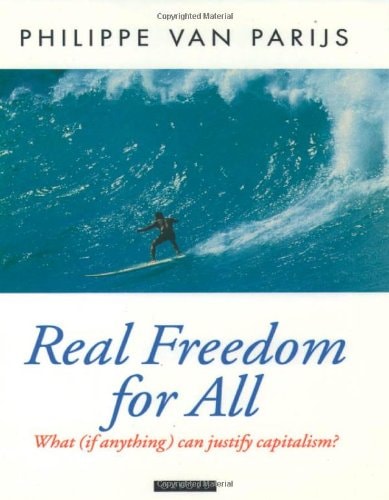
Real Freedom for All: What (If Anything) Can Justify Capitalism?
0
0
As an Amazon Associate and affiliate partner, Menrva Books earns from qualifying purchases. Learn more
Author Description
Capitalist societies are full of unacceptable inequalities. Freedom is of paramount importance. These two convictions, widely shared around the world, seem to be in direct contradiction with each other. Fighting inequality jeopardizes freedom, and taking freedom seriously boosts inequality. Can this conflict be resolved? In this ground-breaking book, Philippe Van Parijs sets a new and compelling case for a just society. Assessing and rejecting the claims of both socialism and conventional capitalism, he presents a clear and compelling alternative vision of the just society: a capitalist society offering a substantial and unconditional basic income to all its members. Not just an exercise in political theory, this book reveals a new ideal of a free society and its meaning in the real world by drawing out its policy implications. It is essential reading for anyone concerned about the just society and the welfare state as we move into the twenty-first century.
Menrva's Summary
THE THESIS
Can the tension between the pursuit of economic equality and the preservation of individual freedom be resolved within a capitalist framework? Philippe Van Parijs, a prominent political philosopher, examines the inherent conflicts between egalitarian goals and liberal freedoms. He evaluates existing socialist and capitalist models before proposing a synthesis centered on the implementation of a universal, unconditional basic income as a mechanism for achieving a truly free and just society.
THE SCOPE MAP
What You Will Find
- A critical evaluation of traditional socialist and capitalist economic theories.
- The conceptual framework for a real-freedom-based approach to social justice.
- An analysis of the policy implications of an unconditional basic income.
- A philosophical defense of the welfare state in the context of modern liberal democracy.
THE AUTHORITY PERSPECTIVE
Scholars and political theorists frequently cite this work as a foundational text for the modern universal basic income debate. Readers often note the rigorous analytical density of the prose, which requires careful engagement with the author's philosophical arguments.
Page Count:
344
Publication Date:
1995-07-27
Publisher:
Oxford University Press
ISBN-10:
0198279051
ISBN-13:
9780198279051
Economics
Philosophy
Economics
Income
Guaranteed Annual Income
BASIC Needs
Social justice
Political Theory
Community Tags
Similar Books