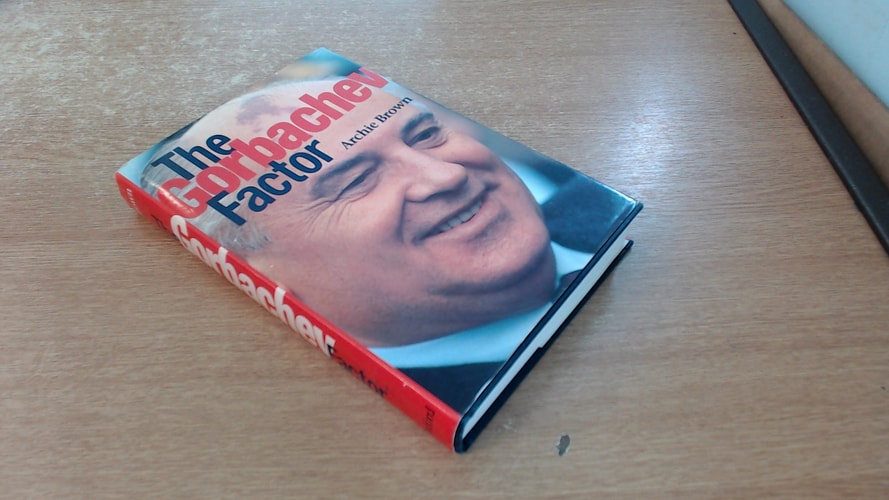
The Gorbachev Factor
0
0
As an Amazon Associate and affiliate partner, Menrva Books earns from qualifying purchases. Learn more
Author Description
General Secretary of the Soviet Communist Party and political reformer, winner of the Nobel Peace Prize and the force behind perestroika, Mikhail Gorbachev was arguably the most important statesman of the twentieth century. When he assumed power in March 1985, it was unimaginable that the Soviet Union would, in the space of seven years, be transformed out of existence. Enormous obstacles confronted any leader intent on changing the Soviet system radically-- centuries of authoritarian government in Russia had been followed by almost seventy years of Soviet rule. Today, however, the changes in what used to be the Soviet Union have been so great--and peaceful-- that it is easy to forget what the unreformed Soviet system was like when Mikhail Gorbachev succeeded Konstantin Chernenko.Providing a balanced account of the complexities of politics in the U.S.S.R. during a period of remarkable change, The Gorbachev Factor tells the gripping story of Gorbachev's rise and fall, a story full of intrigue, secret meetings, and power struggles. Author Archie Brown, one of the world's leading authorities on Gorbachev and the first Western writer to predict his importance, sets out to comprehend the evolution of Gorbachev's thinking and to identify and evaluate his personal contribution to change in Soviet politics. He analyses the thrust of Gorbachev's domestic and foreign policy, looks at the sources of his new ideas, and assesses his contribution to the radical changes that took place in the Soviet Union. Brown shows how Gorbachev moved beyond reform of the Soviet system to the demolition of a number of its pillars. As he came to power in 1985, Gorbachev said, "I thought that we had a system that could be improved. Instead, I learned that we had a system that needed to be replaced." And, in a matter of years, the Soviet system quietly folded under his leadership. In the process of describing Gorbachev, Brown also provides portraits of Soviet leaders through the years--Brezhnev, Andropov, and Chernenko.
Menrva's Summary
THE THESIS
This book investigates the extent to which Mikhail Gorbachev’s personal political evolution and decision-making were the primary catalysts for the collapse of the Soviet Union. Author Archie Brown, a preeminent scholar of Soviet politics, utilizes his extensive access to historical records and his early recognition of Gorbachev’s potential to construct a detailed analysis of the leader's tenure. The text argues that Gorbachev’s transition from a reformer of the Soviet system to an architect of its dismantling was a unique historical phenomenon driven by his specific ideological shifts and pragmatic responses to systemic failure.
THE SCOPE MAP
What You Will Find
- A detailed examination of the political climate in the U.S.S.R. from the Brezhnev era through the collapse of the Soviet state.
- An analysis of the intellectual origins of perestroika and the evolution of Gorbachev's domestic and foreign policy.
- Comparative portraits of key Soviet figures, including Brezhnev and Chernenko, to contextualize Gorbachev's rise.
- A critical evaluation of the structural versus individual factors that led to the peaceful dissolution of the Soviet system.
THE AUTHORITY PERSPECTIVE
Experts and historians frequently cite this work as a foundational text for understanding the internal mechanics of the late Soviet period. Readers often note the academic rigor and the author's unique ability to synthesize complex political power struggles into a coherent historical narrative.
Page Count:
444
Publication Date:
1996-07-18
Publisher:
Oxford University Press
ISBN-10:
0198273444
ISBN-13:
9780198273448
History
Politics
Biography
Soviet Union
Cold War
European History
Community Tags
Other Editions(2)
Similar Books



Reader Comments
Share Your Thoughts
No comments yet. Be the first to share your thoughts!