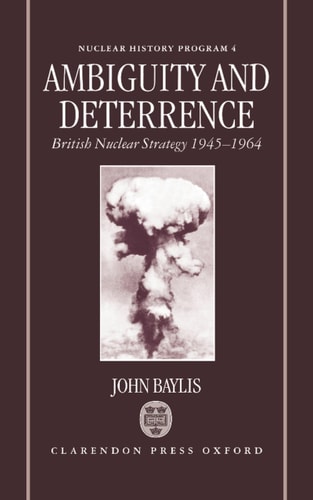
Ambiguity and Deterrence: British Nuclear Strategy 1945-1964
0
0
As an Amazon Associate and affiliate partner, Menrva Books earns from qualifying purchases. Learn more
Author Description
Ambiguity and Deterrence focuses on the role of competing strategic beliefs in the formulation of British nuclear strategy between 1945 and 1964. Based on recently released documents, it is argued that the British approach to nuclear weapons during this formative period was characterized by paradox and ambiguity. The paradox was that while there was a widespread consensus in political and military circles in favour of nuclear deterrence, there were constant disagreements over the requirements of an effective deterrent policy. These disagreements centred on six main questions: whether deterrence was best achieved through "punishment" or "denial"; whether detterence necessitated nuclear superiority; whether preparations had to be made for a long war or a short war; what strategic implications followed from nuclear stalemate; whether limited nuclear wars could be fought without escalation to all-out nuclear war; and whether pre-emption was politically acceptable and militarily necessary. It is argued that the failure of successive governments to provide clear political direction on these issues meant that British nuclear strategy was more ambiguous and much less coherent than is usually supposed.
Menrva's Summary
THE THESIS
This work investigates the core question of how competing strategic beliefs and a lack of political consensus shaped the development of British nuclear policy during the early Cold War. John Baylis, a recognized scholar in international politics and security studies, utilizes recently declassified government documents to analyze the formative years of the United Kingdom's nuclear program. He argues that the British approach was defined by inherent paradoxes and a persistent failure to establish a coherent strategic doctrine, resulting in an ambiguous deterrent policy between 1945 and 1964.
THE SCOPE MAP
What You Will Find
- Analysis of British nuclear policy formulation from 1945 to 1964.
- Examination of six primary strategic debates including punishment versus denial and the feasibility of limited nuclear war.
- Evidence derived from recently released primary source government documents.
- A critical assessment of the disconnect between political consensus and military implementation.
THE AUTHORITY PERSPECTIVE
Experts and historians frequently cite this work as a foundational text for understanding the complexities of British Cold War defense policy. Readers often note the academic density of the prose, which provides a rigorous examination of the internal disagreements that defined the era's strategic landscape.
Page Count:
512
Publication Date:
1996-02-01
Publisher:
Clarendon Press
ISBN-10:
0198280122
ISBN-13:
9780198280125
History
Military History
International relations
Nuclear weapons
Nuclear Strategy
Community Tags
Similar Books