Rationality, Allocation, and Reproduction
0
0
As an Amazon Associate and affiliate partner, Menrva Books earns from qualifying purchases. Learn more
Author Description
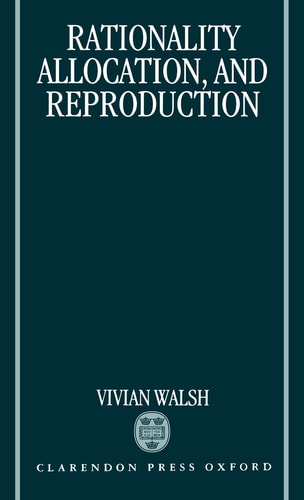
When the term `rational' is used in formal economic theory, a strict definition is implicit. This strict definition cannot accommodate the complexities of our everyday ideas of what is rational. The concept of rationality that is embedded in our language is not a morally neutral one. It has always been believed possible to argue rationally about the worthiness of goals, the legitimacy of claim to rights, the existence of obligations or duties. Outside the discussions of the social sciences, argument concerning the rationality of a choice or action is never a purely technical, value-free discourse.This book is devoted to an examination of the limitations of the various formulations and interpretations of the concept of rationality which has been developed by economic theorists. It presents a series of challenges to the formal (axiomatic) concept of rationality. This concept has spread from economics and decision theory through the social sciences and policy studies. It forms the implicit foundation for the pronouncement of policy-makers, whose recommendations can seriously affect the society and environment in which we live.The book begins with the claim of neoclassical economics that a rational agent maximizes utility. Next it considers the later, more austere construction of rationality where a rational agent was simply one whose choices or actions were consistent. The discussion then turns to who, dissatisfied with this bare notion of consistency, claimed that a rational agent was one whose choices or actions were directed towards maximization of the agent's self-interested aims - a view they attributed (misleadingly?) to Adam Smith. Once the character of the individual agent has been established, neoclassical theory has always regarded the analysis of allocation among these agents as its supreme task. This is the subject of chapters 6 and 7.Vivian Walsh examines the philosophical implications of the replacement of the ordinary concept of rationality by the formal
Menrva's Summary
THE THESIS
This book investigates the limitations of formal, axiomatic definitions of rationality within economic theory and their subsequent impact on social policy. Vivian Walsh, an economist and philosopher, critiques the neoclassical assumption that rationality is a value-free, technical construct. By tracing the evolution of the rational agent from utility maximizer to self-interested actor, the author argues that these narrow definitions fail to capture the moral and social complexities inherent in human decision-making.
THE SCOPE MAP
What You Will Find
- A critical analysis of neoclassical utility maximization models.
- An examination of the shift toward consistency-based definitions of rationality.
- A historical review of the interpretation of Adam Smith's views on self-interest.
- Philosophical implications of replacing ordinary language concepts with formal economic axioms.
THE AUTHORITY PERSPECTIVE
Experts recognize this work as a significant critique of the foundations of modern economic theory. Readers frequently note the academic density of the prose, which requires a strong background in economic philosophy to fully grasp the author's arguments.
Page Count:
320
Publication Date:
1996-09-12
Publisher:
Clarendon Press
ISBN-10:
0198287720
ISBN-13:
9780198287728
Economics
Philosophy
Social Science
Economic Theory
Rationalism
Community Tags
Similar Books