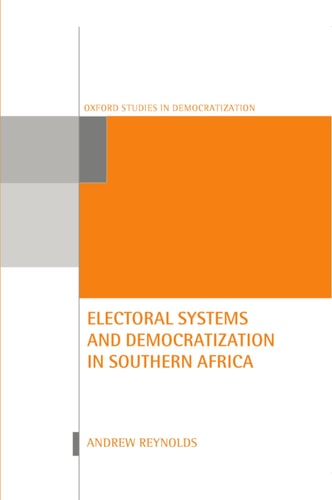
Electoral Systems and Democratization in Southern Africa
0
0
As an Amazon Associate and affiliate partner, Menrva Books earns from qualifying purchases. Learn more
Author Description
This is a groundbreaking comparative study of the effect of institutional design on representation, political stability, and inter-ethnic/racial accommodation in the emerging democracies of Southern Africa. Analyzing the experiences of Malawi, Namibia, South Africa, Zambia, and Zimbabwe, the author presents a host of revealing conclusions that help shed light on the success or failure of democratic design in other fledgling democracies.
Menrva's Summary
THE THESIS
This book investigates how specific institutional designs and electoral systems influence political stability and democratic consolidation within the unique socio-political landscapes of Southern Africa. Andrew Reynolds, a scholar specializing in constitutional design and electoral systems, utilizes a comparative framework to evaluate the performance of various democratic models. By examining the political trajectories of five distinct nations, the author argues that the choice of electoral rules significantly dictates the success of representation and inter-ethnic accommodation in emerging democracies.
THE SCOPE MAP
What You Will Find
- Comparative analysis of electoral systems in Malawi, Namibia, South Africa, Zambia, and Zimbabwe.
- Evaluation of institutional design impacts on political stability and minority representation.
- Empirical data regarding the correlation between electoral rules and inter-ethnic or racial conflict mitigation.
- Theoretical framework for assessing the success or failure of democratic institutions in post-colonial contexts.
THE AUTHORITY PERSPECTIVE
Experts in comparative politics identify this work as a foundational text for understanding the intersection of constitutional engineering and democratic transition in the Southern African region. Readers frequently note the academic density of the prose and the precision of the comparative methodology employed throughout the study.
Page Count:
360
Publication Date:
1999-05-20
Publisher:
Oxford University Press
ISBN-10:
0198295103
ISBN-13:
9780198295105
Comparative Politics
Democracy
Africa Southern
Government
Community Tags
Other Editions(2)
Similar Books