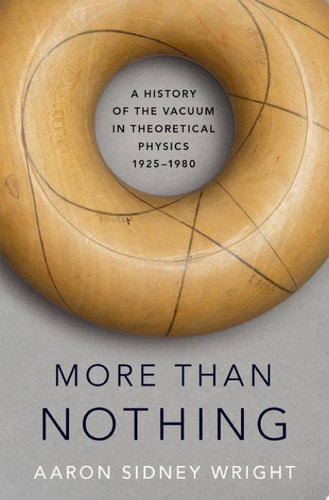
More than Nothing: A History of the Vacuum in Theoretical Physics, 1925-1980
0
0
As an Amazon Associate and affiliate partner, Menrva Books earns from qualifying purchases. Learn more
Author Description
The vacuum is central to physicists' best theories of subatomic particles, gravitation, and cosmology. Nothingness provides the reference point with which to compare new particle creation and annihilation. Cosmologists use empty universes to study the causal structure of spacetime. Paradoxically, our best physical theories of particles, gravity, and spacetime are theories of nothingness. Stranger still, the physicists' vacuum is a hive of activity. Quantum fluctuations fill empty space with particles, and astronomers measure gravitational waves, the vibrations of empty spacetime itself.More than Nothing uses the history of the vacuum to show how technical concepts in physics are made real through everyday practice. It provides new insight into the development of twentieth-century theoretical physics through sustained analysis of understudied figures including John Wheeler's geometrodynamics and Sidney Coleman's false vacuum. It reveals the surprising influence on physicists from the psychology of impossible objects to drawings of the black hole, and the ways in which the development of the physics of the vacuum became inseparable from the development of larger cultural movements in aesthetics, art, psychology, and fiction. Across decades and across disciplines, More than Nothing shows how physicists over and again chose to study the vacuum for insight into the world around them.Drawing on newly unearthed laboratory notes, private letters, and published material, More than Nothing offers a scoping history of the vacuum as a lens into the development of modern physics.
Menrva's Summary
THE THESIS
This book investigates how the concept of the vacuum evolved from a state of emptiness into a complex, active theoretical construct within twentieth-century physics. Aaron Sidney Wright, a historian of science, utilizes a combination of archival laboratory notes, private correspondence, and published scientific literature to trace this intellectual development. He argues that the vacuum serves as a critical lens for understanding how theoretical physics interacts with broader cultural, aesthetic, and psychological movements.
THE SCOPE MAP
What You Will Find
- A detailed historical analysis of theoretical physics between 1925 and 1980.
- Examination of specific concepts including John Wheeler's geometrodynamics and Sidney Coleman's false vacuum.
- Exploration of the intersection between physics and external fields such as art, psychology, and fiction.
Scope Limits
- The text focuses primarily on theoretical developments rather than experimental verification of vacuum energy.
- The analysis is constrained to the period between 1925 and 1980.
THE AUTHORITY PERSPECTIVE
Scholars in the history of science recognize this work for its interdisciplinary approach to technical physics. Readers frequently note the academic density of the prose, which requires a foundational understanding of twentieth-century physics to fully appreciate the author's arguments.
Page Count:
408
Publication Date:
2024-01-01
Publisher:
Oxford University Press
ISBN-10:
0190062800
ISBN-13:
9780190062804
Non-Fiction
Philosophy history
Science History
Theoretical Physics
Philosophy of
Schools & Teaching
Cosmology
Education Teaching
Community Tags
Similar Books