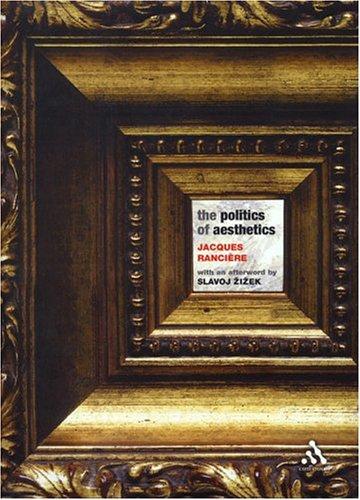
The Politics of Aesthetics: The Distribution of the Sensible
0
0
As an Amazon Associate and affiliate partner, Menrva Books earns from qualifying purchases. Learn more
Author Description
The Politics of Aesthetics rethinks the relationship between art and politics outside of the models established by the Marxist tradition, the Frankfurt School, and the more recent contributions made by the post-structuralists. Reclaiming aesthetics from the narrow confines it is often reduced to, Jacques Ranciere reveals its intrinsic link to politics by analyzing what they both have in common: the delimitation of the visible and the invisible, the audible and the inaudible, the thinkable and the unthinkable, the possible and the impossible. Presented as a series of interlinked interviews, The Politics of Aesthetics provides the most comprehensive introduction to Ranciere's work to date. Ranging across the history of art and politics from the Greek polis to the aesthetic revolution of the modern age, it includes incisive analyses of the uses and abuses of the concept of modernity, the relationship between art and mechanical reproduction, the logic of facts and fiction in history, the positive contradiction at work in modern literature, and the notion of politicized art.--Jacket.
Menrva's Summary
THE THESIS
The Politics of Aesthetics investigates the intrinsic link between art and politics by examining their shared function in defining what is perceptible and imperceptible. Jacques Ranciere challenges traditional Marxist, Frankfurt School, and post-structuralist models, arguing that aesthetics is not merely an artistic domain but a fundamental political act. The book explores how art, through its capacity to delimit the visible and the invisible, the audible and the inaudible, actively shapes our understanding of the possible and impossible within society. Presented through interlinked interviews, it offers a broad survey of this relationship from ancient Greece to modern aesthetics.
THE SCOPE MAP
- What You Will Find:
- Re-evaluation of the relationship between art and politics beyond established theoretical frameworks.
- Analysis of aesthetics as a means of delimiting the perceptible (visible/invisible, audible/inaudible).
- Exploration of the concept of modernity in art and politics.
- Examination of art's role in relation to mechanical reproduction.
- Discussion of the logic of facts and fiction in historical representation.
- Analysis of politicized art and its contradictions.
THE AUTHORITY PERSPECTIVE
The book is regarded as a significant contribution to contemporary thought, offering a novel perspective on the intersection of art and politics that moves beyond conventional critical approaches. Its structure as a series of interviews makes complex ideas accessible, providing a comprehensive introduction to Ranciere's influential work. The analysis of how art shapes our perception of reality and possibility has been noted for its critical depth. Readers and scholars alike have found its redefinition of aesthetics and politics to be a powerful lens for understanding contemporary cultural and political discourse.
Page Count:
116
Publication Date:
2004-01-01
ISBN-10:
082647067X
ISBN-13:
9780826470676
Philosophy
Non-Fiction
Art Theory
Political Theory
Community Tags
Similar Books