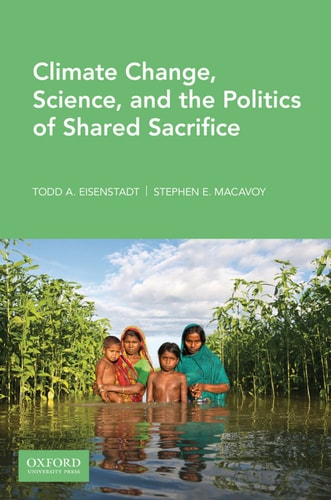
Climate Change, Science, and The Politics of Shared Sacrifice
0
0
As an Amazon Associate and affiliate partner, Menrva Books earns from qualifying purchases. Learn more
Author Description
Designed for undergraduate courses that cover climate change politics within environmental studies, politics, and international relations courses, Climate Change, Science, and The Politics of Shared Sacrifice integrates science and policy within each chapter by considering technical issues as well as their political implications. It reflects the recent changes in US climate policy under President Biden, as well as by other international actors, and covers recent technological advances, including carbon capture, storage and solar energy efficiency. This text presents the questions students need to address in an interdisciplinary approach to perhaps the most encompassing and "wicked" threat to our well-being in the 21st Century. It addresses the impacts of climate change, the history of international negotiations leading to the Paris Agreement and its possible "ambition gap," approaches to decarbonization by nations and economic sectors, and efforts to construct post-fossil fuel energy systems. It also considers implications of recent technological advancements in energy and its distribution, the debate about the "social cost of carbon," the economic costs of adapting to climate change, and the proper roles of individuals versus governments, corporations, and environmental groups. More than a dozen applied exercises and case studies at the conclusion of each chapter further illustrate the timeliness of the subject matter and give students "hands on" experience with role-playing exercises as United Nations negotiators, or Peruvian peasants suing a German utility company, to give a few examples. The text addresses the "collective action problem" early in the text, discussing the strength of the scientific evidence, the failure to come to terms with related social and political problems, and the scope of the problem and why so little has been done. At a theoretical level, the text addresses the discord between theories of collective action and interest groups for explain
Menrva's Summary
THE THESIS
This text investigates the complex intersection of climate science, international policy, and the political challenges inherent in achieving shared global sacrifice to mitigate environmental degradation. Authors Stephen MacAvoy and Todd A. Eisenstadt utilize their academic backgrounds to synthesize technical climate data with political theory, providing a framework for understanding why collective action remains elusive despite clear scientific evidence. The book argues that addressing the climate crisis requires an interdisciplinary approach that balances technological innovation with the realities of international negotiation and economic policy.
THE SCOPE MAP
What You Will Find
- Analysis of international climate negotiations including the Paris Agreement.
- Examination of technological advancements such as carbon capture and solar energy efficiency.
- Theoretical exploration of collective action problems and interest group dynamics.
- Applied pedagogical tools including role-playing exercises and case studies.
Scope Limits
- The text focuses primarily on undergraduate-level academic instruction rather than exhaustive primary scientific research.
- It does not provide a comprehensive technical manual for engineering specific energy systems.
THE AUTHORITY PERSPECTIVE
Educators and students frequently utilize this text as a foundational resource for interdisciplinary environmental studies courses. Experts highlight the book's effectiveness in bridging the gap between complex scientific data and the practical realities of political decision-making.
Page Count:
124
Publication Date:
2021-07-08
Publisher:
Oxford University Press Academic US
ISBN-10:
0190063858
ISBN-13:
9780190063856
Energy policy
International relations
Public Policy
Climate Change
Community Tags
Similar Books


Reader Comments
Share Your Thoughts
No comments yet. Be the first to share your thoughts!