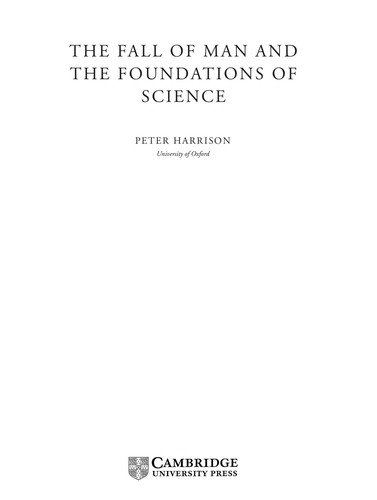
Fall of Man and the Foundations of Science
0
0
As an Amazon Associate and affiliate partner, Menrva Books earns from qualifying purchases. Learn more
Author Description
Peter Harrison provides a new account of the religious foundations of scientific knowledge. He shows how the new approaches to the study of nature that emerged in the sixteenth and seventeenth centuries were directly informed by theological discussions about the Fall of Man and the extent to which the mind and the senses had been damaged by that primeval event. Scientific methods, he suggests, were originally devised as techniques for ameliorating the cognitive damage wrought by human sin. At its inception, modern science was conceptualized as a means of recapturing the knowledge of nature that Adam had once possessed. Contrary to a widespread view which sees science emerging in conflict with religion, Harrison argues that theological considerations were of vital importance in the framing of the new scientific method.--Jacket.
Menrva's Summary
THE THESIS
This book investigates the profound influence of theological concepts, specifically the Fall of Man, on the development of early modern science. Peter Harrison, a renowned historian of science, examines how religious discussions about the cognitive damage caused by original sin shaped the scientific methods of the sixteenth and seventeenth centuries. He argues that the pursuit of scientific knowledge was initially conceived as a way to restore humanity's lost understanding of nature, mirroring Adam's pre-Fall knowledge. This perspective challenges the notion of an inherent conflict between religion and science, positing instead that theological considerations were fundamental to the very framing of the new scientific method.
THE SCOPE MAP
- What You Will Find:
- Theological discussions surrounding the Fall of Man and its impact on human intellect and senses.
- The development of scientific methods in the 16th and 17th centuries as a response to perceived cognitive damage.
- The concept of modern science as a means to recapture pre-Fall knowledge of nature.
- Analysis of primary sources from the period to support the argument.
- A re-evaluation of the relationship between religion and the emergence of modern science.
THE AUTHORITY PERSPECTIVE
Peter Harrison's work is recognized for its rigorous scholarship and its novel argument regarding the religious underpinnings of scientific methodology. Scholars have noted the book's detailed examination of theological debates and their direct influence on scientific thought during a pivotal historical period. The book is considered essential reading for understanding the complex interplay between faith and reason in the formation of modern science. It offers a compelling counter-narrative to the traditional view of science and religion as perpetually at odds.
Page Count:
300
Publication Date:
2007-01-01
ISBN-10:
0521875595
ISBN-13:
9780521875592
Science
Non-Fiction
History
Intellectual History
Community Tags
Similar Books