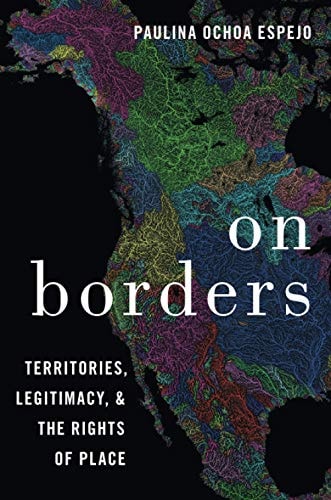
On Borders: Territories, Legitimacy, and the Rights of Place: Territories, Legitimacy, and the Rights of Place
0
0
As an Amazon Associate and affiliate partner, Menrva Books earns from qualifying purchases. Learn more
Author Description
When are borders justified? Who has a right to control them? Where should they be drawn?Today people think of borders as an island's shores. Just as beaches delimit a castaway's realm, so borders define the edges of a territory, occupied by a unified people, to whom the land legitimately belongs. Hence a territory is legitimate only if it belongs to a people unified by a civic identity. Sadly, this Desert Island Model of territorial politics forces us to choose. If we want territories, then we can either have democratic legitimacy, or inclusion of different civic identities--but not both. The resulting politics creates mass xenophobia, migrant-bashing, hoarding of natural resources, and border walls.To escape all this, On Borders presents an alternative model. Drawing on an intellectual tradition concerned with how land and climate shape institutions, it argues that we should not see territories as pieces of property owned by identity groups. Instead, we should see them as watersheds: as interconnected systems where institutions, people, the biota, and the land together create overlapping civic duties and relations, what the book calls place-specific duties.This Watershed Model argues that borders are justified when they allow us to fulfill those duties; that border-control rights spring from internationally-agreed conventions--not from internal legitimacy; that borders should be governed cooperatively by the neighboring states and the states system; and that border redrawing should be done with environmental conservation in mind. The book explores how this model undoes the exclusionary politics of desert islands.
Menrva's Summary
THE THESIS
This book investigates the moral and political justification of borders by challenging the prevailing 'Desert Island Model' of territorial sovereignty. Paulina Ochoa Espejo, a political theorist, utilizes historical intellectual traditions and contemporary political analysis to critique the idea that territories must be owned by unified identity groups. She proposes a 'Watershed Model' that redefines territories as interconnected systems of civic duties, arguing that legitimacy should be derived from cooperative governance and environmental stewardship rather than exclusionary nationalism.
THE SCOPE MAP
What You Will Find
- A critique of the 'Desert Island Model' of territorial politics.
- The introduction of the 'Watershed Model' as an alternative framework for border management.
- Analysis of the relationship between land, climate, and political institutions.
- Proposals for cooperative border governance and environmental conservation.
Scope Limits
- The text does not provide a specific policy manual for individual border disputes.
- It does not focus on the technical mechanics of physical border security infrastructure.
THE AUTHORITY PERSPECTIVE
Scholars in political theory and international relations identify this work as a significant contribution to the debate on territorial rights and migration. Readers frequently note the academic density of the prose, which is intended for those familiar with political philosophy and institutional theory.
Page Count:
344
Publication Date:
2020-07-02
Publisher:
Oxford University Press
ISBN-10:
0190074205
ISBN-13:
9780190074203
Politics
Human rights
International relations
World politics
Political
Geography
New Used & Rental Textbooks
Politics & Government
Political Philosophy
Anthropology
Cultural
Community Tags
Similar Books