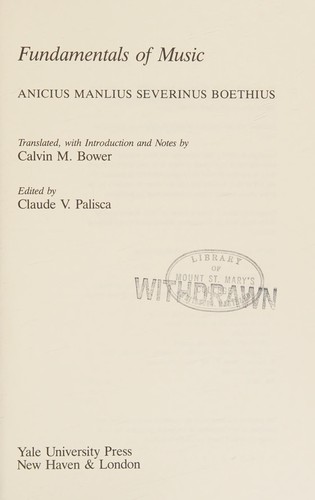
Fundamentals of Music
0
0
As an Amazon Associate and affiliate partner, Menrva Books earns from qualifying purchases. Learn more
Author Description
Boethius's De institutione musica is a seminal work of late antiquity that profoundly influenced the development of Western music theory. Drawing on Greek sources, Boethius systematically explores the mathematical and philosophical underpinnings of music, categorizing it into cosmic, human, and instrumental forms. This treatise provides detailed explanations of musical intervals, scales, and modes, and discusses the ethical and psychological impact of music. It remains an essential text for understanding the transmission of ancient musical knowledge into the Middle Ages.
Menrva's Summary
THE THESIS
The De institutione musica investigates the fundamental principles of music as understood in the ancient world. Boethius, a Roman senator and philosopher, presents a comprehensive treatise that bridges Greek musical theory with Roman practical application. He explores the mathematical underpinnings of harmony, the divisions of the monochord, and the classification of musical modes, aiming to establish a rational and ordered understanding of music's place in the cosmos and its effect on the human soul.
THE SCOPE MAP
- What You Will Find:
- The mathematical and philosophical foundations of music, drawing heavily on Pythagorean and Platonic thought.
- Detailed explanations of musical intervals, scales, and modes.
- Discussions on the three types of music: musica mundana (cosmic harmony), musica humana (harmony of the human body and soul), and musica instrumentalis (audible music).
- An examination of the ethical and psychological effects of music.
- The structure and use of the monochord as a tool for musical measurement and demonstration.
- A historical overview of musical theory from antiquity to Boethius's time.
THE AUTHORITY PERSPECTIVE
Boethius's De institutione musica is a foundational text in the history of Western music theory, serving as a primary source for medieval musical thought. Its systematic approach and integration of mathematics with musical practice made it an authoritative reference for centuries. The work's enduring influence lies in its clear exposition of ancient Greek musical concepts and its role in transmitting this knowledge to the medieval period. Scholars continue to study it for insights into ancient cosmology, philosophy, and the evolution of musical pedagogy.
Page Count:
205
Publication Date:
1989-01-01
ISBN-10:
0300039433
ISBN-13:
9780300039436
Non-Fiction
History
Music
Music theory
Community Tags
Similar Books