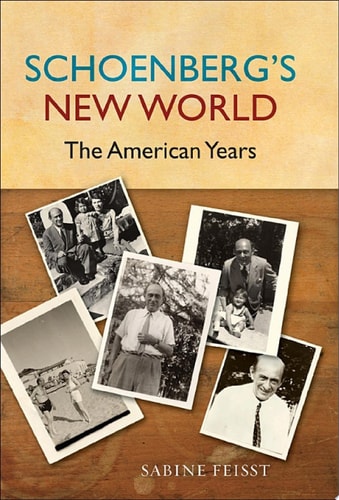
Schoenberg's New World: The American Years
0
0
As an Amazon Associate and affiliate partner, Menrva Books earns from qualifying purchases. Learn more
Author Description
Arnold Schoenberg was a polarizing figure in twentieth century music, and his works and ideas have had considerable and lasting impact on Western musical life. A refugee from Nazi Europe, he spent an important part of his creative life in the United States (1933-1951), where he produced a rich variety of works and distinguished himself as an influential teacher. However, while his European career has received much scholarly attention, surprisingly little has been written about the genesis and context of his works composed in America, his interactions with Americans and other émigrés, and the substantial, complex, and fascinating performance and reception history of his music in this country.Author Sabine Feisst illuminates Schoenberg's legacy and sheds a corrective light on a variety of myths about his sojourn. Looking at the first American performances of his works and the dissemination of his ideas among American composers in the 1910s, 1920s and early 1930s, she convincingly debunks the myths surrounding Schoenberg's alleged isolation in the US. Whereas most previous accounts of his time in the US have portrayed him as unwilling to adapt to American culture, this book presents a more nuanced picture, revealing a Schoenberg who came to terms with his various national identities in his life and work. Feisst dispels lingering negative impressions about Schoenberg's teaching style by focusing on his methods themselves as well as on his powerful influence on such well-known students as John Cage, Lou Harrison, and Dika Newlin. Schoenberg's influence is not limited to those who followed immediately in his footsteps-a wide range of composers, from Stravinsky adherents to experimentalists to jazz and film composers, were equally indebted to Schoenberg, as were key figures in music theory like Milton Babbitt and David Lewin. In sum, Schoenberg's New World contributes to a new understanding of one of the most important pioneers of musical modernism.
Menrva's Summary
THE THESIS
This book investigates the often-misunderstood American period of composer Arnold Schoenberg to determine how his creative output and pedagogical influence shaped the trajectory of twentieth-century American music. Author Sabine Feisst, a scholar of musicology, utilizes archival research, performance records, and correspondence to challenge the prevailing narrative that Schoenberg lived in isolation after fleeing Nazi Europe. By examining his interactions with American institutions, students, and fellow émigrés, Feisst argues that Schoenberg was a dynamic participant in the American musical landscape who actively adapted to his new environment.
THE SCOPE MAP
What You Will Find
- A detailed analysis of Schoenberg's compositions created between 1933 and 1951.
- An examination of his pedagogical methods and their impact on students such as John Cage and Lou Harrison.
- A historical survey of the reception of twelve-tone music within American experimental, jazz, and film composition circles.
- A corrective historical framework addressing myths regarding the composer's alleged inability to assimilate into American culture.
THE AUTHORITY PERSPECTIVE
Experts recognize this work as a vital contribution to musicology that successfully recontextualizes Schoenberg's later career. Readers frequently note the academic density of the prose, which provides a rigorous and well-documented account of a previously under-researched period in the composer's life.
Page Count:
326
Publication Date:
2011-01-01
Publisher:
Oxford University Press
ISBN-10:
0199792631
ISBN-13:
9780199792634
Music
History
Biography
Composers
Music theory
Modernism
Music History
Humanities
Community Tags
Similar Books