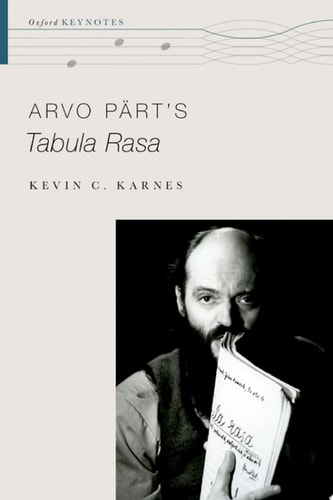
Arvo Pärt's Tabula Rasa
0
0
As an Amazon Associate and affiliate partner, Menrva Books earns from qualifying purchases. Learn more
Author Description
One of today's most widely acclaimed composers, Arvo Pärt broke into the soundscape of the Cold War West with Tabula Rasa in 1977, a work that introduced his signature tintinnabuli style to listeners throughout the world. In the first book dedicated to this pathbreaking composition, author Kevin C. Karnes tells the story of Tabula Rasa as one of Pärt and of Europe itself, traced over the course of a quarter-century that saw momentous transitions in European culture and politics, history and memory. Beginning at the site of the work's creation in the Estonian SSR, and drawing extensively upon a range of previously unexamined archival materials, Karnes recounts Pärt's discovery of tintinnabuli amidst his experiments with the music of the Western and Soviet avant-gardes. He examines Tabula Rasa in relation to modernist conceptions of musical structure, the ascetic practice of Orthodox Christianity, postwar experiences of electronic music, and the polystylistic approaches to composition that have become emblematic of the Soviet 1970s. Tracing the export of Tabula Rasa to the West and Pärt's emigration in 1980, the book reveals intersections of critical commentary with visions of the "end of history" that attended the collapse of European communism to suggest that it was in this confluence of listening, discovery, and geopolitical reordering that enduring lines of conversation about Pärt and his music took shape.
Menrva's Summary
THE THESIS
How did Arvo Pärt’s 1977 composition Tabula Rasa serve as a cultural and political bridge between the Soviet avant-garde and the Western musical consciousness? Author Kevin C. Karnes, a scholar of music history, utilizes archival research and cultural analysis to position this specific work as a reflection of Pärt’s personal evolution and the broader geopolitical shifts in Europe. The text argues that the composition’s emergence and subsequent international reception were inextricably linked to the collapse of communism and the changing landscape of European identity.
THE SCOPE MAP
What You Will Find
- Historical analysis of the Estonian SSR musical environment during the 1970s.
- Technical examination of the tintinnabuli style and its development.
- Contextualization of Pärt’s work within Orthodox Christian asceticism and Soviet polystylism.
- Documentation of the transition of Pärt’s music from the Soviet sphere to the Western market.
Scope Limits
- The book does not provide a comprehensive biography of Pärt’s entire career.
- It does not offer a technical musicological analysis of Pärt’s complete body of work.
THE AUTHORITY PERSPECTIVE
Scholars and music critics recognize this text as a definitive study on the intersection of Pärt’s aesthetic development and the political climate of the late twentieth century. Readers frequently note the academic density of the prose, which provides a rigorous framework for understanding the cultural significance of the tintinnabuli style.
Page Count:
149
Publication Date:
2017-01-01
Publisher:
Oxford University Press
ISBN-10:
0190469005
ISBN-13:
9780190469009
Music
Biography
History
Music History
Humanities
Cultural History
Music theory
Community Tags
Similar Books