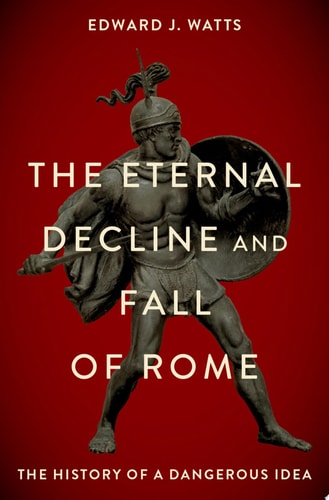
The Eternal Decline and Fall of Rome: The History of a Dangerous Idea
0
0
As an Amazon Associate and affiliate partner, Menrva Books earns from qualifying purchases. Learn more
Author Description
For more than 2000 years, those wishing to rule Rome and leaders inspired by their example have claimed they, and only they, could restore their society's past glory and make it great again. They left millions of victims in their wake. The decline of Rome has been a constant source of discussion for more than 2200 years. Everyone from American journalists in the twenty-first century AD to Roman politicians at the turn of the third century BC have used it as a tool to illustrate the negative consequences of changes in their world. Because Roman history is so long, it provides a buffet of ready-made stories of decline that can help develop the context around any snapshot. And Rome did, in fact, decline and, eventually, fall. An empire that once controlled all or part of more than 40 modern European, Asian, and African countries no longer exists. Roman prophets of decline were, ultimately, proven correct-a fact that makes their modern invocations all the more powerful. If it happened then, it could happen now.The Eternal Decline and Fall of Rome tells the stories of the people who built their political and literary careers around promises of Roman renewal as well as those of the victims they blamed for causing Rome's decline. Each chapter offers the historical context necessary to understand a moment or a series of moments in which Romans, aspiring Romans, and non--Romans used ideas of Roman decline and restoration to seize power and remake the world around them. The story begins during the Roman Republic just after 200 BC. It proceeds through the empire of Augustus and his successors, traces the Roman loss of much of western Europe in the fifth century AD, and then follows Roman history as it runs through the Eastern Roman Empire (Byzantium) until its fall in 1453. The final two chapters look at ideas of Roman decline and renewal from the fifteenth century until today. If Rome illustrates the profound danger of the rhetoric of decline, it also demonstrates the rehabil
Menrva's Summary
THE THESIS
This book investigates how the narrative of Rome's decline has been weaponized over two millennia to justify political power and social transformation. Edward J. Watts, a professor of history, examines the recurring rhetorical pattern where leaders invoke the fall of Rome to frame contemporary changes as catastrophic, thereby positioning themselves as the necessary restorers of lost glory. By analyzing the historical context of these claims, the author demonstrates how the myth of decline has been used to manipulate public perception and consolidate authority from the Roman Republic to the modern era.
THE SCOPE MAP
What You Will Find
- A chronological analysis of Roman political rhetoric from 200 BC through the fall of Byzantium in 1453.
- Examination of modern political discourse that utilizes Roman history to frame contemporary crises.
- Case studies of individuals who built political careers by promising to restore Roman greatness.
Scope Limits
- The text does not provide a comprehensive military or economic history of the Roman Empire.
- It does not offer a definitive objective account of why Rome fell, but rather focuses on the perception of that fall.
THE AUTHORITY PERSPECTIVE
Scholars and readers frequently note the clarity with which Watts deconstructs the political utility of historical narratives. Experts highlight this as a significant contribution to understanding how the rhetoric of decline functions as a tool for political mobilization.
Page Count:
320
Publication Date:
2021-08-03
Publisher:
Oxford University Press
ISBN-10:
0190076712
ISBN-13:
9780190076719
History
World
Civilization
Historiography
Ancient - Rome
Europe
Social History
Medieval
New Used & Rental Textbooks
Rome
General
Community Tags
Similar Books