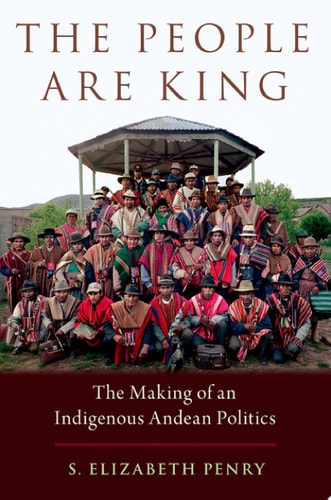
The People Are King: The Making of an Indigenous Andean Politics
0
0
As an Amazon Associate and affiliate partner, Menrva Books earns from qualifying purchases. Learn more
Author Description
In the sixteenth century, in what is now modern-day Peru and Bolivia, Andean communities were forcibly removed from their traditional villages by Spanish colonizers and resettled in planned, self-governed towns modeled after those in Spain. But rather than merely conforming to Spanish cultural and political norms, indigenous Andeans adopted and gradually refashioned the religious practices dedicated to Christian saints and political institutions imposed on them, laying claim to their own rights and the sovereignty of the collective. The People Are King shows how common Andean people produced a new kind of civil society over three centuries of colonialism, merging their traditional understanding of collective life with the Spanish notion of the común to demand participatory democracy. S. Elizabeth Penry explores how this hybrid concept of self-rule spurred the indigenous rebellions that erupted across Latin America in the eighteenth century, not only against Spanish rulers, but against native hereditary nobility, for acting against the will of the comuneros. Through the letters and documents of the Andean people themselves, The People Are King gives voice to a vision of community-based democracy that played a central role in the Age of Atlantic Revolutions and continues to galvanize indigenous movements in Bolivia today.
Menrva's Summary
THE THESIS
This work investigates how indigenous Andean communities in colonial Peru and Bolivia transformed imposed Spanish political structures into a unique, localized form of participatory democracy. S. Elizabeth Penry, a historian specializing in colonial Latin America, utilizes extensive archival research to analyze how indigenous populations navigated the Spanish resettlement policies known as reducciones. By synthesizing primary source documents and letters, the author argues that these communities developed a hybrid political identity that challenged both colonial authorities and internal hereditary elites.
THE SCOPE MAP
What You Will Find
- Analysis of the Spanish común concept and its adaptation by Andean communities.
- Examination of eighteenth-century indigenous rebellions against colonial and native nobility.
- Use of primary source letters and petitions written by indigenous Andeans.
- Historical context regarding the Age of Atlantic Revolutions.
Scope Limits
- The study focuses primarily on the Andean region of Peru and Bolivia rather than the entirety of the Spanish Americas.
- The text does not provide a comprehensive biography of specific revolutionary leaders, focusing instead on collective civil society.
THE AUTHORITY PERSPECTIVE
Scholars and historians frequently cite this work as a significant contribution to the understanding of indigenous agency within colonial frameworks. Readers often note the academic density of the prose, which provides a rigorous examination of how local political structures influenced broader revolutionary movements.
Page Count:
315
Publication Date:
2019-01-01
Publisher:
Oxford University Press
ISBN-10:
0190073926
ISBN-13:
9780190073923
History
Andes Region
History & Theory
Sociology
Power Social sciences
Colonialism
Social Science
Social History
South America
American History
Native American
Community Tags
Similar Books