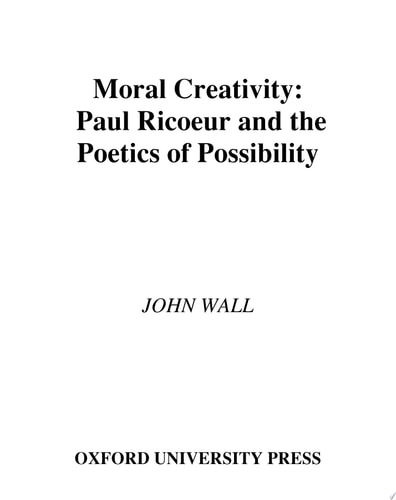
Moral Creativity: Paul Ricoeur and the Poetics of Possibility
0
0
As an Amazon Associate and affiliate partner, Menrva Books earns from qualifying purchases. Learn more
Author Description
In Moral Creativity, John Wall argues that moral life and thought are inherently and radically creative. Human beings are called by their own primordially created depths to exceed historical evil and tragedy through the ongoing creative transformation of their world. This thesis challenges ancient Greek and biblical separations of ethics and poetic image-making, as well as contemporary conceptions of moral life as grounded in abstract principles or preconstituted traditions. Taking as his point of departure the poetics of the will of Paul Ricoeur, and ranging widely into critical conversations with Continental, narrative, feminist, and liberationist ethics, Wall uncovers the profound senses in which moral practice and thought involve tension, catharsis, excess, and renewal. In the process, he draws new connections between sin and tragedy, practice and poetics, and morality and myth. Rather than proposing a complete ethics, Moral Creativity is a meta-ethical work investigating the creative capability as part of what it means, morally, to be human. This capability is explored around four dimensions of ontology, teleology, deontology, and social practice. In each case, Wall examines a traditional perspective on the relation of ethics to poetics, critiques it using resources from contemporary phenomenology, and develops a conception of a more original poetics of moral life. In the end, moral creativity is a human capability for inhabiting tensions among others and in social systems and, in the image of a Creator, creating together an ever more radically inclusive moral world.
Menrva's Summary
THE THESIS
John Wall investigates the core question of whether moral life is fundamentally a creative act rather than merely an adherence to abstract principles or established traditions. Drawing upon the philosophical framework of Paul Ricoeur, Wall argues that human beings possess a primordial capacity to transform their world by navigating tensions and exceeding historical tragedy. He synthesizes insights from Continental, feminist, and liberationist ethics to propose a meta-ethical model that redefines morality as an ongoing, poetic process of renewal.
THE SCOPE MAP
What You Will Find
- A meta-ethical analysis of human moral capability across four dimensions: ontology, teleology, deontology, and social practice.
- A critical dialogue between traditional ethical theories and contemporary phenomenology.
- An exploration of the intersection between moral practice, myth, and poetic image-making.
Scope Limits
- The book does not attempt to provide a complete or prescriptive system of ethics.
- It does not focus on specific policy applications or applied ethics in a practical, day-to-day sense.
THE AUTHORITY PERSPECTIVE
Scholars in the field of religious ethics recognize this work as a significant contribution to the study of Paul Ricoeur’s influence on moral philosophy. Readers frequently note the academic density of the prose, which requires a strong background in Continental philosophy to fully grasp the author's nuanced arguments.
Page Count:
237
Publication Date:
2005-01-01
Publisher:
Oxford University Press
ISBN-10:
0190292954
ISBN-13:
9780190292959
Philosophy
Religion
Phenomenology
Ethics
Moral Philosophy
Theology
Community Tags
Similar Books