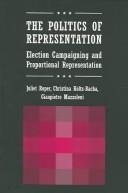
The Politics of Representation
0
0
As an Amazon Associate and affiliate partner, Menrva Books earns from qualifying purchases. Learn more
Author Description
In this new book, an international team of experts critically examines issues of democratic representation in three culturally diverse nations whose governments are elected under systems of proportional representation - New Zealand, Germany, and Italy. The authors examine the power plays at work in the development and implementation of proportional representation in their respective countries and they consider the ways in which the electoral system has impacted election campaign strategies. The final chapter by Douglas Kellner (George F. Kellner Philosophy of Education Chair, Social Sciences and Comparative Education, UCLA) relates the issue to contemporary politics in the United States by using the 2000 U.S. presidential election to investigate the ways in which democracy is served, and disserved, by the electoral system."--Jacket.
Menrva's Summary
THE THESIS
This book investigates the complex interplay between democratic representation and electoral systems in nations utilizing proportional representation. The authors, an international team of experts, critically examine the power dynamics involved in the development and implementation of proportional representation in New Zealand, Germany, and Italy, and analyze its impact on election campaign strategies. Douglas Kellner further contextualizes these issues within contemporary U.S. politics, using the 2000 presidential election to explore how electoral systems both serve and undermine democracy.
THE SCOPE MAP
- Analysis of proportional representation systems in New Zealand, Germany, and Italy.
- Examination of power plays in the development and implementation of electoral systems.
- Impact of electoral systems on election campaign strategies.
- Comparative study of democratic representation across diverse nations.
- Contextualization within contemporary U.S. politics, referencing the 2000 presidential election.
- Discussion of how electoral systems serve and disserve democratic principles.
THE AUTHORITY PERSPECTIVE
The book is presented as a critical examination by an international team of experts, suggesting a scholarly and analytical approach to the subject of democratic representation. The inclusion of a chapter by Douglas Kellner, a noted academic, indicates a focus on rigorous analysis and contemporary relevance, particularly in relation to U.S. politics. The comparative nature of the study across three distinct nations implies a broad scope and a desire to draw nuanced conclusions about the effectiveness of proportional representation systems. The work appears designed for an audience interested in political science, electoral reform, and comparative governance.
Page Count:
185
Publication Date:
2004-01-01
ISBN-10:
0820461482
ISBN-13:
9780820461489
Non-Fiction
Politics
Democracy
Comparative Politics
Electoral Systems
Community Tags
Similar Books