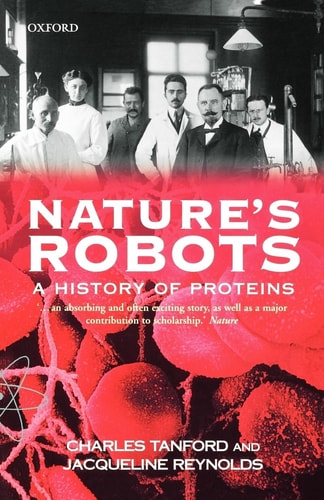
Nature's Robots: A History of Proteins
0
0
As an Amazon Associate and affiliate partner, Menrva Books earns from qualifying purchases. Learn more
Author Description
Proteins are amazing molecules. They spark the chemical reactions that form the basis for life, transmit signals in the body, identify and kill foreign invaders, form the engines that make us move, record visual images. For every task in a living organism, there is a protein designed to carry it out.Nature's Robots is an authoritative history of protein science, from the earliest research in the nineteenth century to the most recent findings today. Tanford and Reynolds, who themselves made major contributions to the golden age of protein science, have written a remarkably vivid account of this history. The authors begin with the research of Berzelius and Mulder into "albumins," the early name for proteins, and the range all the way up to the findings of James Watson and Francis Crick. It is a fascinating story, involving heroes from the past, working mostly alone or in small groups, usually with little support from formal research grants. They capture the growing excitement among scientists as the mysteries of protein structure and function--the core of all the mysteries of life--are revealed little by little. And they include vivid portraits of scientists at work--two researchers, stranded by fog in a Moscow airport, strike up a conversation that leads to a major discovery; a chemist working in a small lab, with little funding, on a problem no one else would tackle, proves that enzymes are proteins--and wins the Nobel Prize.Written in clear and accessible prose, Nature's Robots will appeal to anyone interested in the peaks and valleys of scientific research.
Menrva's Summary
THE THESIS
How did the scientific understanding of proteins evolve from nineteenth-century chemical observations to the modern molecular era? Charles Tanford and Jacqueline Reynolds, both distinguished contributors to the field of protein science, provide a comprehensive historical account of the discipline. They synthesize the development of protein research by examining the transition from early theories about albumins to the discovery of the structural mechanisms that govern life, utilizing a narrative that emphasizes the human element of scientific discovery.
THE SCOPE MAP
What You Will Find
- A chronological history of protein science starting from the nineteenth-century work of Berzelius and Mulder.
- Detailed accounts of the discovery of protein structure and function, including the contributions of Watson and Crick.
- Biographical portraits of key scientists and the often solitary, underfunded conditions of their research.
- An analysis of the shift in scientific methodology from individual experimentation to modern collaborative research.
THE AUTHORITY PERSPECTIVE
Experts and readers alike recognize this work as a significant historical document written by two prominent figures in the field. The text is noted for its accessible prose, which successfully balances technical scientific history with the personal narratives of the researchers involved.
Page Count:
320
Publication Date:
2001-11-08
Publisher:
Oxford University Press
ISBN-10:
0198504667
ISBN-13:
9780198504665
Non-Fiction
History
Science
Proteins
Biology
Chemistry