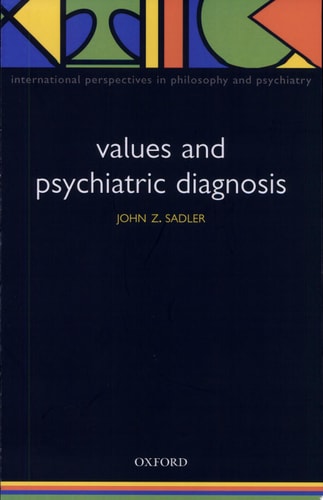
Values and Psychiatric Diagnosis
0
0
As an Amazon Associate and affiliate partner, Menrva Books earns from qualifying purchases. Learn more
Author Description
The public, mental health consumers, as well as mental health practitioners wonder about what kinds of values mental health professionals hold, and what kinds of values influence psychiatric diagnosis. Are mental disorders socio-political, practical, or scientific concepts? Is psychiatric diagnosis value-neutral? What role does the fundamental philosophical question "How should I live?" play in mental health care? In his carefully nuanced and exhaustively referenced monograph, psychiatrist and philosopher of psychiatry John Z. Sadler describes the manifold kinds of values and value judgements involved in psychiatric diagnosis and classification systems like the DSM. Professor Sadler takes the reader on a fascinating conceptual tour of the inner workings of psychiatric diagnosis, considering the role of science, culture, sexuality, politics, gender, technology, human nature, patienthood, and professions in building his vision of a more humane psychiatric diagnostic process.
Menrva's Summary
THE THESIS
This monograph investigates whether psychiatric diagnosis can be considered a value-neutral scientific endeavor or if it is inherently shaped by socio-political and philosophical value judgments. John Z. Sadler, a psychiatrist and philosopher, utilizes his dual expertise to deconstruct the diagnostic frameworks found in systems like the DSM. He argues that the process of defining mental disorder is inextricably linked to broader questions regarding human nature, ethics, and the societal expectations of how one should live. By examining the intersection of clinical practice and moral philosophy, Sadler provides a framework for understanding the hidden biases within diagnostic classification.
THE SCOPE MAP
What You Will Find
- An analysis of the role of culture, gender, and sexuality in the construction of psychiatric categories.
- A philosophical examination of the DSM and other diagnostic classification systems.
- A critique of the scientific versus socio-political nature of mental health concepts.
- A proposed vision for a more humane and transparent diagnostic process in clinical settings.
THE AUTHORITY PERSPECTIVE
Experts in the field of philosophy of psychiatry recognize this work as a foundational text for understanding the ethical dimensions of clinical diagnosis. Readers frequently note the academic density of the prose, which requires a strong background in both clinical psychiatry and philosophical inquiry to fully appreciate the author's arguments.
Page Count:
556
Publication Date:
2004-12-23
Publisher:
Oxford University Press
ISBN-10:
0198526377
ISBN-13:
9780198526377
Philosophy
Sociology
Mental Illness
Medical Ethics
Psychiatry
Mental Health
Community Tags
Similar Books