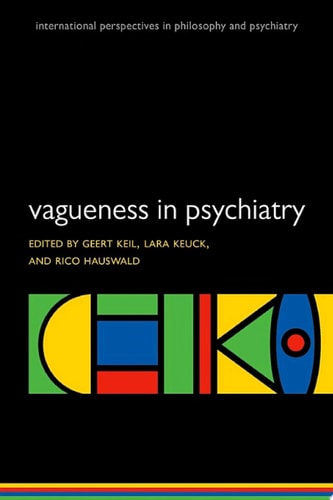
Vagueness in Psychiatry
0
0
As an Amazon Associate and affiliate partner, Menrva Books earns from qualifying purchases. Learn more
Author Description
In psychiatry there is no sharp boundary between the normal and the pathological. Although clear cases abound, it is often indeterminate whether a particular condition does or does not qualify as a mental disorder. For example, definitions of subthreshold disorders and of the prodromal stages of diseases are notoriously contentious. Philosophers and linguists call concepts that lack sharp boundaries, and thus admit of borderline cases, vague. Although blurred boundaries between the normal and the pathological are a recurrent theme in many publications concerned with the classification of mental disorders, systematic approaches that take into account philosophical reflections on vagueness are rare. This book provides interdisciplinary discussions about vagueness in psychiatry by bringing together scholars from psychiatry, psychology, philosophy, history, and law. It draws together various lines of inquiry into the nature of gradations between mental health and disease and discusses the individual and societal consequences of dealing with blurred boundaries in medical practice, forensic psychiatry, and beyond. Part I starts with an overview chapter that helps readers to navigate through the philosophy of vagueness and through the various debates surrounding demarcation problems in the classification and diagnosis of mental illness. Part II encompasses historical and recent philosophical positions on gradualist approaches to health and disease. Part III approaches the vagueness of present psychiatric classification systems and the debates concerning their revision by scrutinizing controversial categories such as post-traumatic stress disorder and by looking into the difficulties of day-to-day diagnostic and therapeutic practice. Part IV finally focuses on social, moral, and legal implications that arise when being mentally ill is a matter of degree.
Menrva's Summary
THE THESIS
This book investigates the conceptual and practical challenges posed by the lack of sharp boundaries between mental health and pathological states in psychiatric diagnosis. The authors, Geert Keil, Lara Keuck, and Rico Hauswald, curate an interdisciplinary collection of essays that apply philosophical theories of vagueness to the classification of mental disorders. By integrating perspectives from psychiatry, psychology, history, law, and philosophy, the text argues that the indeterminate nature of mental illness requires a more nuanced, gradualist approach to clinical and forensic practice.
THE SCOPE MAP
What You Will Find
- Philosophical frameworks regarding the nature of vague concepts and borderline cases.
- Historical and contemporary analysis of gradualist models of health and disease.
- Critical examination of diagnostic categories such as post-traumatic stress disorder.
- Discussions on the social, moral, and legal ramifications of diagnosing mental illness as a matter of degree.
Scope Limits
- The text does not provide a definitive clinical manual or diagnostic algorithm for specific disorders.
- It does not offer a singular, unified theory of psychiatry but rather presents a collection of diverse interdisciplinary viewpoints.
THE AUTHORITY PERSPECTIVE
Experts highlight this work as a significant contribution to the philosophy of psychiatry, noting its success in bridging the gap between abstract philosophical inquiry and clinical diagnostic reality. Readers frequently observe that the prose maintains a high level of academic rigor, making it a valuable resource for scholars and practitioners interested in the conceptual foundations of mental health classification.
Page Count:
275
Publication Date:
2016-01-01
Publisher:
OUP Oxford
ISBN-10:
0191034053
ISBN-13:
9780191034053
Philosophy
Psychiatry
Philosophy of
Mental Health
Medical
Medical Ethics
Allied Health
Community Tags
Similar Books