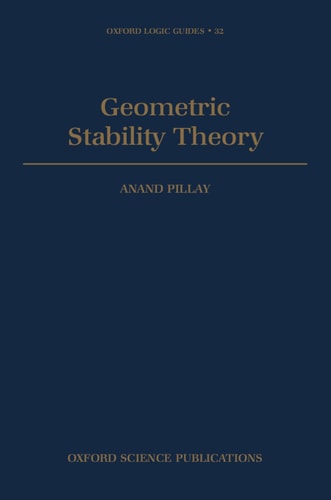
Geometric Stability Theory
0
0
As an Amazon Associate and affiliate partner, Menrva Books earns from qualifying purchases. Learn more
Author Description
This book gives an account of the fundamental results in geometric stability theory, a subject that has grown out of categoricity and classification theory. This approach studies the fine structure of models of stable theories, using the geometry of forking; this often achieves global results relevant to classification theory. Topics range from Zilber-Cherlin classification of infinite locally finite homogenous geometries, to regular types, their geometries, and their role in superstable theories. The structure and existence of definable groups is featured prominently, as is work by Hrushovski. The book is unique in the range and depth of material covered and will be invaluable to anyone interested in modern model theory.
Menrva's Summary
THE THESIS
This text investigates the fundamental results and structural properties of geometric stability theory as it evolved from classification theory. Anand Pillay, a prominent researcher in model theory, provides a rigorous account of how the geometry of forking allows for the analysis of stable theories. The book synthesizes complex model-theoretic concepts to explain how local geometric structures inform global classification results.
THE SCOPE MAP
What You Will Find
- Analysis of Zilber-Cherlin classification of infinite locally finite homogenous geometries
- Examination of regular types and their specific geometric properties
- Investigation into the structure and existence of definable groups
- Application of Hrushovski's work within the context of superstable theories
THE AUTHORITY PERSPECTIVE
Experts recognize this volume as a foundational text for those specializing in modern model theory. Readers frequently note the high level of technical density, which requires a strong background in mathematical logic to fully comprehend the material.
Page Count:
376
Publication Date:
1996-11-07
Publisher:
Clarendon Press
ISBN-10:
019853437X
ISBN-13:
9780198534372
Model theory
Geometry
Logic
Mathematics
Community Tags
Similar Books