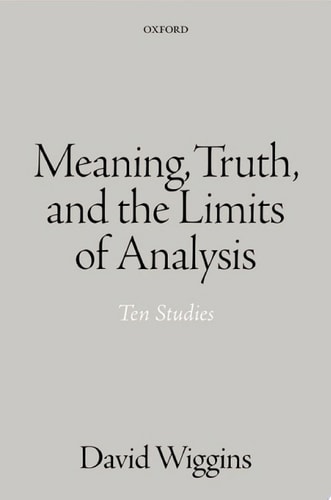
Meaning, Truth, and the Limits of Analysis: Ten Studies
0
0
As an Amazon Associate and affiliate partner, Menrva Books earns from qualifying purchases. Learn more
Author Description
This volume draws together work by David Wiggins on topics to do with language, meaning, truth, and the limit of semantic analysis, from 1980 to 2020. Each chapter draws upon previously published material, but that material has been revised, sometimes significantly, for republication here. Opening with a selective account of a century's work in the philosophy of meaning, from Frege and Wittgenstein to the late twentieth century, the book engages first with the nuts and bolts of sentence-construction: predicates and the copula, quantifiers, names, existence treated as a second-level predicate, and adverbial modification. The following five chapters then treat of definition and (as dreamt of by Leibniz and others) the terminus of semantic analysis; the idea of natural languages as real things with a history; the idea of truth conceived as correlative with inquiry (C. S. Peirce) and, finally, the properties we look for in truth itself--the marks, as Frege or Leibniz might have said, of the concept true.
Menrva's Summary
THE THESIS
This volume investigates the foundational problems of meaning, truth, and the boundaries of semantic analysis within the tradition of analytic philosophy. David Wiggins, a prominent philosopher known for his work on identity and ethics, synthesizes four decades of research to examine how language functions and the limits of our ability to define its core components. He employs a rigorous analytical framework to bridge historical philosophical inquiries with contemporary semantic theory.
THE SCOPE MAP
What You Will Find
- Historical overview of the philosophy of meaning from Frege to the late twentieth century
- Technical analysis of sentence construction including predicates, quantifiers, and adverbial modification
- Examination of truth as a concept correlative with inquiry
- Theoretical exploration of natural languages as historical entities
Scope Limits
- The text does not provide an exhaustive history of all linguistic philosophy
- It focuses primarily on analytic traditions rather than continental or structuralist approaches
THE AUTHORITY PERSPECTIVE
Experts recognize this collection as a significant synthesis of Wiggins's long-standing contributions to the field of semantics. Readers frequently note the high level of academic density and the requirement for a strong background in formal logic to fully engage with the arguments presented.
Page Count:
200
Publication Date:
2022-01-01
Publisher:
OUP Oxford
ISBN-10:
0191039179
ISBN-13:
9780191039171
Philosophy
Semantics
Language
Logic
Epistemology
Community Tags
Similar Books