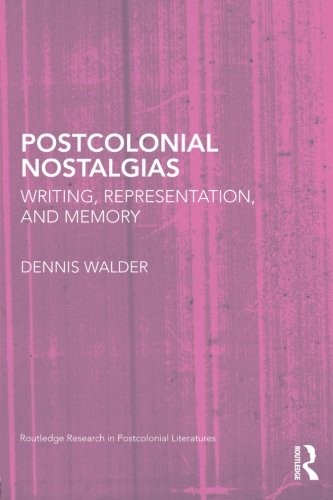
Postcolonial Nostalgias
0
0
As an Amazon Associate and affiliate partner, Menrva Books earns from qualifying purchases. Learn more
Author Description
This book offers an original and informed critique of a widespread yet often misunderstood condition -- nostalgia, a pervasive human emotion connecting people across national and historical as well as personal boundaries. Often seen as merely escapist, nostalgia also offers solace and self-understanding for those displaced by the larger movements of our time. Walder analyses the writings of some of those entangled in the aftermath of empire, tracing the hidden connections underlying their yearnings for a common identity and a homeland, and their struggles to recover their histories. Through a series of comparative reflections upon the representation in literary and related cultural forms of memory, he shows how admitting the past into the present through nostalgia enables former colonial or diasporic subjects to gain a deeper understanding of the networks of power within which they are caught in the modern world and beyond which it may yet be possible to move. Considering authors as varied as V.S Naipaul, J.G. Ballard, Doris Lessing, W.G. Sebald, and Chimamanda Ngozi Adichie, as well as versions of 'Bushman' song, Walder pursues the often wayward, ambiguous paths of nostalgia as it has been represented beyond, but also within, Europe, so as to identify some of those processes of communal and individual experience that constitute the present and, by implication, the future.
Menrva's Summary
THE THESIS
This book critically examines the complex and often misunderstood emotion of nostalgia, particularly as it relates to the aftermath of empire and displacement. Dennis Walder, an established scholar in postcolonial studies, analyzes the writings of authors entangled in the post-imperial world, exploring their yearnings for identity and homeland. The book investigates how these writers, through literary and cultural forms, grapple with memory, revealing how confronting the past through nostalgia can lead to a deeper understanding of power structures and potential pathways forward.
THE SCOPE MAP
- Analysis of nostalgia as a condition connecting people across national, historical, and personal boundaries.
- Critique of nostalgia as more than mere escapism, offering solace and self-understanding to displaced individuals.
- Examination of writings by authors affected by the aftermath of empire, tracing connections in their search for identity and homeland.
- Exploration of how literary and cultural forms represent memory and the recovery of histories.
- Comparative reflections on the representation of nostalgia in literary and related cultural forms.
- Consideration of authors such as V.S. Naipaul, J.G. Ballard, Doris Lessing, W.G. Sebald, and Chimamanda Ngozi Adichie.
- Analysis of 'Bushman' song and other cultural expressions of nostalgia beyond and within Europe.
- Identification of processes of communal and individual experience that constitute the present and future through the lens of nostalgia.
THE AUTHORITY PERSPECTIVE
This book is recognized for its original and informed critique of nostalgia within postcolonial contexts. Scholars likely appreciate its nuanced approach, moving beyond simplistic views of nostalgia as escapist to explore its role in providing solace and self-understanding for those affected by displacement. The comparative analysis of diverse literary and cultural forms, featuring prominent authors, offers a rich exploration of memory and identity formation in the aftermath of empire. The work is positioned to deepen understanding of the complex networks of power and the construction of present and future experiences.
Page Count:
214
Publication Date:
2012-01-01
ISBN-10:
0415628296
ISBN-13:
9780415628297
Literary Fiction
History
Fiction
Non-Fiction
Literary Criticism
Memory Studies
Nostalgia