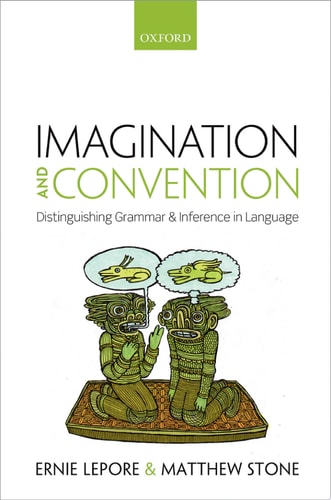
Imagination and Convention: Distinguishing Grammar and Inference in Language
0
0
As an Amazon Associate and affiliate partner, Menrva Books earns from qualifying purchases. Learn more
Author Description
What do speakers mean? What do they convey? What do they reveal? How do they invite us to think? Communication exploits conventional rules, deliberate choices, and many other faculties. How? A common answer invokes simple meanings and general ways to reinterpret them, as in H. P. Grice's theory of conversational implicature. Lepore and Stone show such answers are unsatisfactory. Instead, they argue that language provides diverse tools for making ideas public, and that communication recruits distinct kinds of imagination. The work synthesizes results from across cognitive science into a profoundly new account of meaning in language.
Menrva's Summary
THE THESIS
This book investigates the fundamental mechanisms of human communication by challenging the traditional reliance on Gricean conversational implicature to explain how speakers convey meaning. Ernie Lepore and Matthew Stone, both established scholars in philosophy and linguistics, argue that existing models of language are insufficient for capturing the complexity of human interaction. They propose a new framework that posits language as a diverse set of tools that actively recruit human imagination rather than relying solely on conventional rules or simple reinterpretation of literal meanings.
THE SCOPE MAP
What You Will Find
- A critical evaluation of H. P. Grice's theory of conversational implicature and its limitations in explaining speaker intent.
- An interdisciplinary synthesis of research from cognitive science, philosophy of language, and linguistics.
- A proposed model of communication that emphasizes the role of imagination and deliberate choice in making ideas public.
- Analysis of how speakers navigate conventional rules versus creative, context-dependent linguistic strategies.
THE AUTHORITY PERSPECTIVE
Experts in the field of philosophy of language recognize this work as a significant challenge to standard pragmatic theories. Readers frequently note the academic density of the prose, which requires a strong background in linguistic theory to fully grasp the authors' arguments.
Page Count:
272
Publication Date:
2015-02-11
Publisher:
Oxford University Press
ISBN-10:
0198717180
ISBN-13:
9780198717188
Philosophy
Linguistics
Pragmatics
Semantics
Community Tags
Similar Books