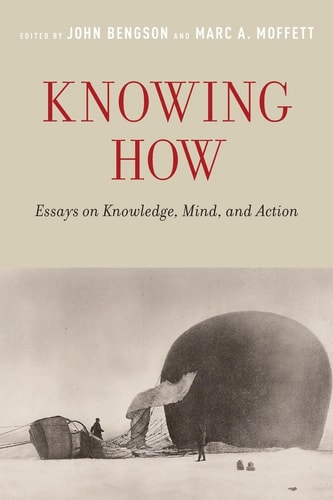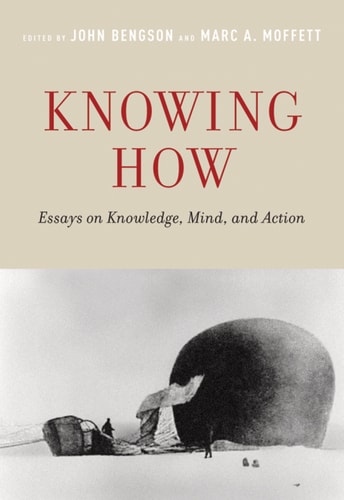
Knowing How: Essays on Knowledge, Mind, and Action
0
0
As an Amazon Associate and affiliate partner, Menrva Books earns from qualifying purchases. Learn more
Author Description
Knowledge how to do things is a pervasive and central element of everyday life. Yet it raises many difficult questions that must be answered by philosophers and cognitive scientists aspiring to understand human cognition and agency. What is the connection between knowing how and knowing that? Is knowledge how simply a type of ability or disposition to act? Is there an irreducibly practical form of knowledge? What is the role of the intellect in intelligent action? This volume contains fifteen state of the art essays by leading figures in philosophy and linguistics that amplify and sharpen the debate between "intellectualists" and "anti-intellectualists" about mind and action, highlighting the conceptual, empirical, and linguistic issues that motivate and sustain the conflict. The essays also explore various ways in which this debate informs central areas of ethics, philosophy of action, epistemology, philosophy of language, and philosophy of mind and cognitive science.Knowing How covers a broad range of topics dealing with tacit and procedural knowledge, the psychology of skill, expertise, intelligence and intelligent action, the nature of ability, the syntax and semantics of embedded questions, the mind-body problem, phenomenal character, epistemic injustice, moral knowledge, the epistemology of logic, linguistic competence, the connection between knowledge and understanding, and the relation between theory and practice.This is the book on knowing how--an invaluable resource for philosophers, linguists, psychologists, and others concerned with knowledge, mind, and action.
Menrva's Summary
THE THESIS
This collection of essays investigates the nature of 'knowledge how' and its relationship to propositional knowledge, agency, and human cognition. Editors John Bengson and Marc A. Moffett assemble fifteen contributions from prominent philosophers and linguists to evaluate the ongoing debate between intellectualists, who argue that knowing how is a form of knowing that, and anti-intellectualists, who maintain that practical knowledge is distinct. The volume provides a rigorous framework for analyzing how these theoretical positions impact broader discussions in ethics, epistemology, and the philosophy of language.
THE SCOPE MAP
What You Will Find
- Analysis of the syntax and semantics of embedded questions.
- Exploration of the psychology of skill, expertise, and intelligent action.
- Discussions on epistemic injustice, moral knowledge, and the epistemology of logic.
- Theoretical frameworks regarding the mind-body problem and phenomenal character.
Scope Limits
- The text does not provide a singular, unified theory but rather presents a spectrum of competing academic viewpoints.
- It does not offer practical 'how-to' guides for skill acquisition, focusing instead on the conceptual and linguistic underpinnings of such abilities.
THE AUTHORITY PERSPECTIVE
Experts identify this volume as a comprehensive resource for scholars and graduate students working at the intersection of philosophy and cognitive science. Readers frequently note the academic density of the prose, which assumes a high level of familiarity with contemporary analytic philosophy.
Page Count:
416
Publication Date:
2012-01-01
Publisher:
Oxford University Press
ISBN-10:
0190452838
ISBN-13:
9780190452834
Philosophy
Philosophy of
Epistemology
Linguistics
Essays
Mind & Body