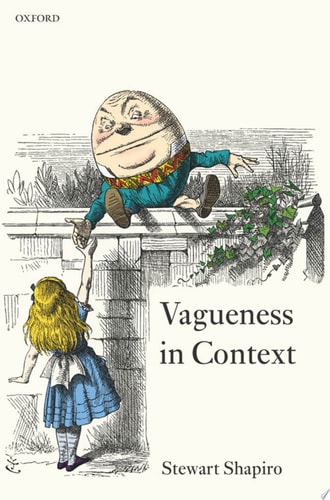
Vagueness in Context
0
0
As an Amazon Associate and affiliate partner, Menrva Books earns from qualifying purchases. Learn more
Author Description
Stewart Shapiro's aim in Vagueness in Context is to develop both a philosophical and a formal, model-theoretic account of the meaning, function, and logic of vague terms in an idealized version of a natural language like English. It is a commonplace that the extensions of vague terms vary with such contextual factors as the comparison class and paradigm cases. A person can be tall with respect to male accountants and not tall (even short) with respect to professional basketball players. The main feature of Shapiro's account is that the extensions (and anti-extensions) of vague terms also vary in the course of a conversation, even after the external contextual features, such as the comparison class, are fixed. A central thesis is that in some cases, a competent speaker of the language can go either way in the borderline area of a vague predicate without sinning against the meaning of the words and the non-linguistic facts. Shapiro calls this open texture, borrowing the term from Friedrich Waismann. The formal model theory has a similar structure to the supervaluationist approach, employing the notion of a sharpening of a base interpretation. In line with the philosophical account, however, the notion of super-truth does not play a central role in the development of validity. The ultimate goal of the technical aspects of the work is to delimit a plausible notion of logical consequence, and to explore what happens with the sorites paradox. Later chapters deal with what passes for higher-order vagueness - vagueness in the notions of 'determinacy' and 'borderline' - and with vague singular terms, or objects. In each case, the philosophical picture is developed by extending and modifying the original account. This is followed with modifications to the model theory and the central meta-theorems. As Shapiro sees it, vagueness is a linguistic phenomenon, due to the kinds of languages that humans speak. But vagueness is also due to the world we find ourselves in, as we try to
Menrva's Summary
THE THESIS
This work investigates the semantic and logical properties of vague terms within natural language, specifically focusing on how their extensions shift based on conversational context. Stewart Shapiro, a prominent philosopher of logic and mathematics, utilizes a model-theoretic framework to analyze how vague predicates function. He argues that competent speakers possess a degree of freedom when applying vague terms in borderline cases, a concept he terms open texture, which challenges traditional binary truth-value assignments.
THE SCOPE MAP
What You Will Find
- A formal model-theoretic account of vague predicates and their extensions.
- An analysis of the sorites paradox within a contextualist framework.
- A discussion on higher-order vagueness and vague singular terms.
- Theoretical applications of Friedrich Waismann's concept of open texture.
Scope Limits
- The analysis is restricted to an idealized version of natural language rather than empirical linguistic data.
- The text does not provide a comprehensive survey of all competing theories of vagueness, focusing primarily on the author's specific model.
THE AUTHORITY PERSPECTIVE
Scholars in the field of philosophy of language recognize this text as a significant contribution to the debate on vagueness and contextualism. Readers frequently note the technical density of the prose, which requires a strong background in formal logic and semantic theory to fully grasp the proposed meta-theorems.
Page Count:
240
Publication Date:
2006-01-01
Publisher:
OUP Oxford
ISBN-10:
0191535672
ISBN-13:
9780191535673
Philosophy
Semantics
Linguistics
Logic & Critical Reasoning
Logic
Philosophy of
Community Tags
Other Editions(3)

Similar Books



Reader Comments
Share Your Thoughts
No comments yet. Be the first to share your thoughts!