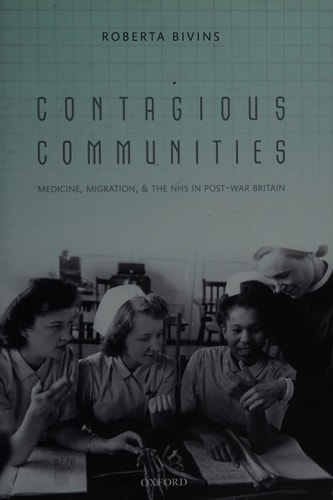
Contagious Communities: Medicine, Migration, and the NHS in Post War Britain
0
0
As an Amazon Associate and affiliate partner, Menrva Books earns from qualifying purchases. Learn more
Author Description
It was only a coincidence that the NHS and the Empire Windrush (a ship carrying 492 migrants from Britain's West Indian colonies) arrived together. On 22 June 1948, as the ship's passengers disembarked, frantic preparations were already underway for 5 July, the Appointed Day when the nation's new National Health Service would first open its doors. The relationship between immigration and the NHS rapidly attained - and has enduringly retained - notable political and cultural significance.Both the Appointed Day and the post-war arrival of colonial and Commonwealth immigrants heralded transformative change. Together, they reshaped daily life in Britain and notions of 'Britishness' alike. Yet the reciprocal impacts of post-war immigration and medicine in post-war Britain have yet to be explored. Contagious Communities casts new light on a period which is beginning to attract significant historical interest. Roberta Bivins draws attention to the importance - but also the limitations - of medical knowledge, approaches, and professionals in mediating post-war British responses to race, ethnicity, and the emergence of new and distinctive ethnic communities. By presenting a wealth of newly available or previously ignored archival evidence, she interrogates and re-balances the political history of Britain's response to New Commonwealth immigration. Contagious Communities uses a set of linked case-studies to map the persistence of 'race' in British culture and medicine alike; the limits of belonging in a multi-ethnic welfare state; and the emergence of new and resolutely 'unimagined' communities of patients, researchers, clinicians, policy-makers, and citizens within the medical state and its global contact zones.
Menrva's Summary
THE THESIS
This work investigates the complex, reciprocal relationship between post-war immigration to Britain and the development of the National Health Service (NHS). Roberta Bivins, a historian specializing in the history of medicine, utilizes archival evidence to analyze how medical institutions and professionals mediated British societal responses to race and ethnicity. The book argues that the NHS served as a critical site where notions of 'Britishness' and belonging were negotiated during the emergence of a multi-ethnic welfare state.
THE SCOPE MAP
What You Will Find
- Historical analysis of the intersection between the 1948 establishment of the NHS and the arrival of Commonwealth migrants.
- Case studies examining the role of medical knowledge in shaping public policy regarding race and ethnicity.
- Examination of the 'global contact zones' within the British medical system.
- Evaluation of how new, diverse communities of patients and clinicians challenged existing welfare state paradigms.
THE AUTHORITY PERSPECTIVE
Experts recognize this text as a significant contribution to the social history of medicine and post-war British migration. Readers frequently note the depth of the archival research and the clarity with which Bivins connects clinical practice to broader political and cultural shifts in British society.
Page Count:
400
Publication Date:
2015-11-24
Publisher:
Oxford University Press
ISBN-10:
0198725280
ISBN-13:
9780198725282
History
Health Services
Public Health
Public opinion
Great Britain
Migration Studies
Immigrants
Sociology
British History
Medicine
European History
Community Tags
Similar Books