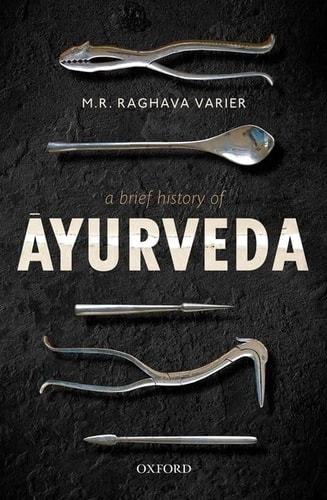
A Brief History of Ayurveda
0
0
As an Amazon Associate and affiliate partner, Menrva Books earns from qualifying purchases. Learn more
Author Description
Following a general trend, Ayurveda is often officially described and commonly known even among its practitioners as 'alternative medicine' whereas the available sources clearly show that it was the mainstream health care programme in the sub-continent for roughly more than two and a half millennia in the past. This is perhaps the result of an inherent indifference to the historical background of the development of the indigenous medicine. Medicine and its practice do not exist in a vacuum nor do they flourish without economic and social necessities. There is no dearth of literature on the history of Ayurveda but most of the available works are in the form of descriptive accounts of or discussions on the content of the classics, their commentaries and so on. Generally speaking, these volumes seldom make any attempt to place the developments in the system of Ayurveda brought in from time to time against their historical context. This is perhaps due to the approaches, which are, as a rule, myopic to the archaeological and epigraphic sources that shed light on many dimly lit areas of the topic. Access to a proper intellectual apparatus and ideational acumen with an appropriate theoretical frame is essential for a meaningful explanation of medicine and its practice in India with special reference to their historical context. The present volume is a humble attempt at viewing the stages of development of Ayurveda which was the mainstream indigenous medicine and its practice placing them in their historical context.
Menrva's Summary
THE THESIS
This book investigates the historical development of Ayurveda as the mainstream healthcare system in the Indian subcontinent, challenging its modern classification as merely 'alternative medicine.' Prof M. R. Raghava Varier utilizes an interdisciplinary approach, integrating archaeological and epigraphic evidence with traditional medical literature to contextualize the evolution of indigenous health practices. The author argues that medicine cannot be understood in a vacuum and must be analyzed through the lens of the economic and social necessities of its time.
THE SCOPE MAP
What You Will Find
- Historical analysis of Ayurveda spanning over two and a half millennia.
- Integration of archaeological and epigraphic data to supplement classical medical texts.
- A theoretical framework for understanding medical evolution within Indian social history.
Scope Limits
- The text does not provide a clinical manual or a guide to practicing Ayurvedic medicine.
- It does not focus on modern pharmacological comparisons or contemporary clinical trials.
THE AUTHORITY PERSPECTIVE
Scholars and historians of medicine recognize this work as a significant effort to move beyond descriptive accounts of classical texts toward a rigorous historical contextualization. Readers frequently note the academic density of the prose, which provides a scholarly foundation for understanding the socio-economic drivers of ancient Indian medical systems.
Page Count:
204
Publication Date:
2020-10-22
Publisher:
Oxford University Press
ISBN-10:
0190121084
ISBN-13:
9780190121082
Health
Non-Fiction
History
Medicine
India
Ayurveda
Community Tags
Similar Books