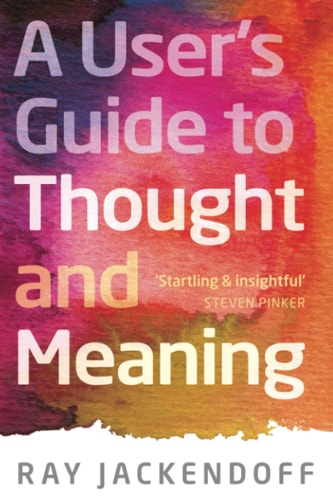
A User's Guide to Thought and Meaning
0
0
As an Amazon Associate and affiliate partner, Menrva Books earns from qualifying purchases. Learn more
Author Description
Hailed as a "masterpiece" (Nature) and as "the most important book in the sciences of language to have appeared in many years" (Steven Pinker), Ray Jackendoff's Foundations of Language was widely acclaimed as a landmark work of scholarship that radically overturned our understanding of how language, the brain, and perception intermesh. A User's Guide to Thought and Meaning is Jackendoff's most important book since his groundbreaking Foundations of Language. Written with an informality that belies the originality of its insights, it presents a radical new account of the relation between language, meaning, rationality, perception, consciousness, and thought, and, extraordinarily, does this in terms a non-specialist will grasp with ease. Jackendoff starts out by looking at languages and what the meanings of words and sentences actually do. Finding meanings to be more adaptive and complicated than they're commonly given credit for, he is led to some basic questions: how do we perceive and act in the world? How do we talk about it? And how can the collection of neurons in the brain give rise to conscious experience? He shows that the organization of language, thought, and perception does not look much like the way we experience things, and that only a small part of what the brain does is conscious. He concludes that thought and meaning must be almost completely unconscious. What we experience as rational conscious thought--which we prize as setting us apart from the animals--in fact rides on a foundation of unconscious intuition. Rationality amounts to intuition enhanced by language. Ray Jackendoff's profound and arresting account will appeal to everyone interested in the workings of the mind, in how language links to the world, and in what understanding these means for the way we experience our lives.
Menrva's Summary
THE THESIS
How does the human brain generate conscious thought and meaning from unconscious processes? Ray Jackendoff, a prominent cognitive scientist, investigates the intersection of language, perception, and rationality. By examining the disconnect between our conscious experience and the underlying neural mechanisms, he argues that what we perceive as rational thought is actually a product of unconscious intuition facilitated by language.
THE SCOPE MAP
What You Will Find
- Analysis of the relationship between linguistic structures and semantic meaning
- Examination of how sensory perception informs our interaction with the physical world
- Discussion on the limitations of consciousness in cognitive processing
- Theoretical framework for understanding rationality as an extension of intuition
THE AUTHORITY PERSPECTIVE
Experts and readers alike recognize this work as a significant follow-up to the author's previous scholarship, noting its accessibility for non-specialists. The text is frequently cited for its ability to distill complex cognitive theories into clear, manageable concepts for a general audience.
Page Count:
288
Publication Date:
2015-06-01
Publisher:
Oxford University Press
ISBN-10:
0198736452
ISBN-13:
9780198736455
Psychology
Linguistics
English
Thought And Thinking
Neuroscience
English & College Success
Community Tags
Similar Books