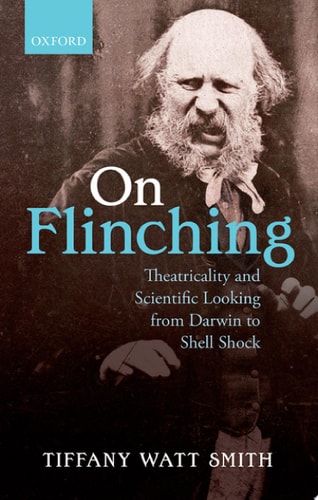
On Flinching: Theatricality and Scientific Looking from Darwin to Shell Shock
0
0
As an Amazon Associate and affiliate partner, Menrva Books earns from qualifying purchases. Learn more
Author Description
While the end of the nineteenth century is often associated with the rise of objectivity and its ideal of a restrained observer, scientific experiments continued to create emotional, even theatrical, relationships between scientist and his subject. On Flinching focuses on moments in which scientific observers flinched from sudden noises, winced at the sight of an animal's pain or cringed when he was caught looking, as ways to consider a distinctive motif of passionate and gestured looking in the laboratory and beyond. It was not their laboratory machines who these scientific observers most closely resembled, but the self-consciously emotional theatrical audiences of the period. Tiffany Watt-Smith offers close readings of four experiments performed by the naturalist Charles Darwin, the physiologist David Ferrier, the neurologist Henry Head, and the psychologist Arthur Hurst. Bringing together flinching scientific observers with actors and spectators in the late nineteenth and early twentieth century theatre, it places the history of scientific looking in its wider cultural context, arguing that even at the dawn of objectivity the techniques and problems of the stage continued to haunt scientific life. In turn, it suggests that by exploring the ways recoiling, shrinking and wincing becoming paradigmatic spectatorial gestures in this period, we can understand the ways Victorians thought about looking as itself an emotional and gestured performance.
Menrva's Summary
THE THESIS
This book investigates how the physical act of flinching by scientific observers during the late nineteenth and early twentieth centuries reveals the persistent influence of theatricality on the development of scientific objectivity. Tiffany Watt Smith, a cultural historian, utilizes archival records of laboratory experiments to argue that the ideal of the detached, restrained scientist was frequently undermined by involuntary emotional responses. By analyzing these moments of physical recoil, the author demonstrates that scientific observation was deeply intertwined with the gestural performances common to the period's theatre.
THE SCOPE MAP
What You Will Find
- Analysis of experiments conducted by Charles Darwin, David Ferrier, Henry Head, and Arthur Hurst
- Examination of the intersection between laboratory observation and Victorian theatrical spectatorship
- Historical exploration of involuntary physical gestures such as wincing, shrinking, and cringing
Scope Limits
- The study focuses primarily on the late nineteenth and early twentieth centuries
- It does not provide a comprehensive history of all scientific observation methods during this era
THE AUTHORITY PERSPECTIVE
Scholars in the history of science and performance studies recognize this work for its original synthesis of laboratory practices and cultural history. Readers frequently note the academic density of the prose and the author's meticulous attention to the physical nuances of historical scientific observation.
Page Count:
272
Publication Date:
2014-01-01
Publisher:
OUP Oxford
ISBN-10:
0191004359
ISBN-13:
9780191004353
Psychology
Theatre studies
English & College Success
Science History
Cultural History
English
Community Tags
Similar Books