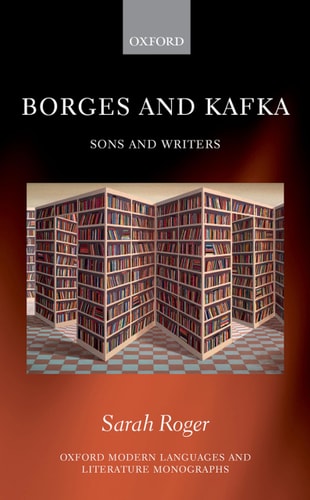
Borges and Kafka: Sons and Writers
0
0
As an Amazon Associate and affiliate partner, Menrva Books earns from qualifying purchases. Learn more
Author Description
Sarah Roger investigates Jorge Luis Borges's development as an author in light of Franz Kafka's influence, and in consideration of Borges's relationship with his father, Jorge Guillermo Borges (Borges pere, a failed author). Borges believed that much of Kafka's writing derived from his personal experiences, particularly his relationship with his father. This book looks at how reading Kafka helped Borges mediate and make productive use of his own relationship with his father, and it offers a thorough analysis of Borges pere's writing, which is supplemented by an appendix that reprints Borges pere's poetry for the first time.Borges and Kafka also provides extensive analysis of Kafka's presence in Borges's critical writing, his translations, and the stories that he modelled on Kafka. Particular attention is paid to the concepts that Borges identified as Kafka's obsessions: subordination, infinity, and hierarchical relationships, which Borges referred to as the "patria potestad." Roger's analysis is accompanied by an annotated bibliography documenting every mention of Kafka in Borges's writing and a list of every Kafka text Borges read. Kafka's influence is especially evident in the stories where Borges was openly imitating Kafka--"La loteria en Babilonia" (1941), "La biblioteca de Babel" (1941), and "El Congreso" (1971)--but it features throughout Ficciones. Reading Borges's writing in light of his interest in Kafka demonstrates his focus not just on the individual's subordinate place in an infinite hierarchy but also on the repercussions these circumstances had for a struggling author like Borges, who was seeking to define himself through his writing.
Menrva's Summary
THE THESIS
This study investigates how the literary influence of Franz Kafka served as a psychological and creative catalyst for Jorge Luis Borges as he navigated his complex relationship with his father. Sarah Roger, an expert in modern languages, utilizes biographical records, critical essays, and textual analysis to argue that Borges projected his own familial anxieties onto his interpretation of Kafka. By examining the concept of 'patria potestad'—or hierarchical subordination—Roger demonstrates how Borges transformed his personal struggle for artistic identity into a foundational element of his own literary output.
THE SCOPE MAP
What You Will Find
- A detailed examination of the influence of Jorge Guillermo Borges on his son's creative development.
- Comparative analysis of Kafka's themes of infinity and hierarchy within Borges's short stories.
- An annotated bibliography documenting every reference to Kafka in the works of Borges.
- A unique appendix featuring the first-ever reprint of poetry written by Borges's father.
THE AUTHORITY PERSPECTIVE
Scholars and critics recognize this work as a rigorous contribution to the study of Borges's intellectual history and creative process. Readers frequently note the academic density of the prose, which provides a comprehensive framework for understanding the intersection of biography and literary imitation.
Page Count:
228
Publication Date:
2017-03-06
Publisher:
Oxford University Press
ISBN-10:
0198746156
ISBN-13:
9780198746157
Biography
Literary Criticism
Comparative
Literary theory
Community Tags
Similar Books