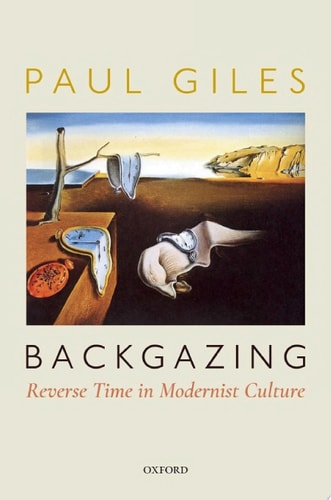
Backgazing: Reverse Time in Modernist Culture
0
0
As an Amazon Associate and affiliate partner, Menrva Books earns from qualifying purchases. Learn more
Author Description
This volume trace ways in which time is represented in reverse forms throughout modernist culture, from the beginning of the twentieth century until the decade after World War II. Though modernism is often associated with revolutionary or futurist directions, this book argues instead that a retrograde dimension is embedded within it. By juxtaposing the literature of Europe and North America with that of Australia and New Zealand, it suggests how this antipodean context serves to defamiliarize and reconceptualize normative modernist understandings of temporal progression. Backgazing thus moves beyond the treatment of a specific geographical periphery as another margin on the expanding field of 'New Modernist Studies'. Instead, it offers a systematic investigation of the transformative effect of retrograde dimensions on our understanding of canonical modernist texts. The title, 'backgazing', is taken from Australian poet Robert G. FitzGerald's 1938 poem 'Essay on Memory', and it epitomizes how the cultural history of modernism can be restructured according to a radically different discursive map. Backgazing intellectually reconfigures US and European modernism within a planetary orbit in which the literature of Australia and the Southern Hemisphere, far from being merely an annexed margin, can be seen substantively to change the directional compass of modernism more generally. By reading canonical modernists such as James Joyce and T. S. Eliot alongside marginalized writers such as Nancy Cunard and others and relatively neglected authors from Australia and New Zealand, this book offers a revisionist cultural history of modernist time, one framed by a recognition of how its measurement is modulated across geographical space.
Menrva's Summary
THE THESIS
This volume investigates how retrograde temporal representations function as a core, rather than peripheral, element within modernist culture from the early twentieth century through the post-World War II era. Paul Giles, a scholar of modernist literature and cultural history, utilizes a comparative framework that juxtaposes canonical European and North American texts with literature from Australia and New Zealand. He argues that the Southern Hemisphere perspective acts as a critical lens to reorient our understanding of modernist temporal progression, challenging the traditional view of modernism as exclusively forward-looking or futurist.
THE SCOPE MAP
What You Will Find
- A comparative analysis of modernist literature spanning Europe, North America, Australia, and New Zealand.
- A theoretical framework for 'backgazing' as a method of cultural and temporal restructuring.
- Close readings of canonical figures like James Joyce and T. S. Eliot alongside marginalized or regional writers.
Scope Limits
- The study does not provide an exhaustive survey of all modernist literature, focusing instead on specific texts that illustrate the retrograde temporal thesis.
- The analysis does not extend significantly beyond the immediate post-World War II decade.
THE AUTHORITY PERSPECTIVE
Scholars in the field of New Modernist Studies recognize this work for its contribution to decentering traditional Anglo-American narratives of the period. Readers frequently note the academic density of the prose and the rigorous nature of the comparative methodology employed by the author.
Page Count:
322
Publication Date:
2019-01-01
Publisher:
OUP Oxford
ISBN-10:
0192566210
ISBN-13:
9780192566218
History
Literary Criticism
Comparative
Indigenous
Cultural History
Modernism
Community Tags
Similar Books