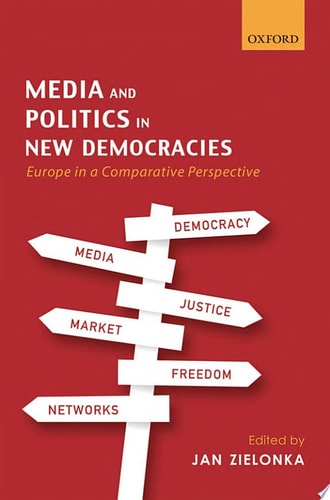
Media and Politics in New Democracies: Europe in a Comparative Perspective
0
0
As an Amazon Associate and affiliate partner, Menrva Books earns from qualifying purchases. Learn more
Author Description
This book analyses the relationship between the media and politics in new democracies in Europe and other parts of the world. It does so from both theoretical and empirical angles.How is power being mediated in new democracies? Can media function independently in the unstable and polarised political environment experienced after the fall of autocracy? Do major shifts in economic and ownership structures help or hinder the quality of the media? How much can new media laws alter old journalistic habits and political cultures? And how do new technologies impact the media and democracy? The book examines these questions, drawing on a vast set of data assembled by a large international project.Media and Politics in New Democracies focuses chiefly on new democracies in Central and Eastern Europe, but chapters analysing new democracies in Latin America, Africa, and Southeast Asia are also included. These new democracies represent a variety of what sociologists call 'glocalism': homogenisation and heterogenisation coexist, revealing hybrid models and multiple modernities. It is local culture that assigns meaning to global and regional influences. 'Ideal' liberal models and best practices are being promoted and aspired to, but these models and practices are often being adopted in opaque ways generating results opposite to those intended. The book finds many new democracies to be fragile if not deficient, and tries to show what is really going on in these countries, how they compare to each other, and what they can learn from each other.
Menrva's Summary
THE THESIS
This book investigates how the relationship between media and political institutions functions within the volatile environments of emerging democracies. Jan Zielonka, a prominent scholar in European politics, synthesizes theoretical frameworks with empirical data from an extensive international research project. The work argues that while liberal democratic models are often promoted as universal standards, their implementation in new democracies frequently results in hybrid, opaque systems that diverge significantly from Western expectations.
THE SCOPE MAP
What You Will Find
- Comparative analysis of media systems in Central and Eastern Europe, Latin America, Africa, and Southeast Asia.
- Examination of the impact of ownership structures and economic shifts on journalistic independence.
- Evaluation of how new media laws interact with entrenched political cultures and journalistic habits.
- Discussion of the role of new technologies in shaping democratic discourse and political polarization.
THE AUTHORITY PERSPECTIVE
Experts recognize this work as a significant contribution to the study of democratic transitions and media institutionalization. Readers frequently note the academic density of the prose and the breadth of the comparative data provided across diverse geographic regions.
Page Count:
312
Publication Date:
2015-12-08
Publisher:
Oxford University Press
ISBN-10:
0198747535
ISBN-13:
9780198747536
Media Studies
Sociology
Mass media
Comparative Politics
Democracy
International relations
Community Tags
Similar Books