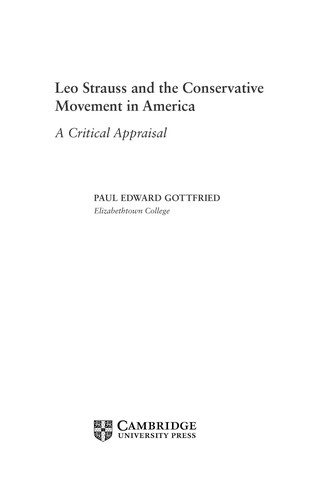
Leo Strauss and the Conservative Movement in America
0
0
As an Amazon Associate and affiliate partner, Menrva Books earns from qualifying purchases. Learn more
Author Description
This book offers an original interpretation of the achievement of Leo Strauss, stressing how his ideas and followers reshaped the American conservative movement. According to this study, Strauss and his disciples came to influence the establishment Right almost by accident. The conservative movement that reached out to Strauss and his legacy was extremely fluid and lacked a self-confident leadership. Conservative activists and journalists felt a desperate need for academic acceptability, which they thought Strauss and his disciples would furnish. They also became deeply concerned with the problem of "value relativism," which self-described conservatives thought Strauss had effectively addressed. But until recently, neither Strauss nor his disciples have considered themselves to be "conservatives." Strauss's followers continue to view themselves as stalwart Truman-Kennedy Democrats and liberal internationalists. Contrary to another misconception, Straussians have never wished to convert Americans to ancient political ideals and practices, except in a very selective rhetorical fashion. Strauss and his disciples have been avid champions of American modernity, and "timeless" values as interpreted by Strauss and his followers often look starkly contemporary.
Menrva's Summary
THE THESIS
This book examines the unexpected influence of philosopher Leo Strauss and his followers on the shaping of the American conservative movement. The study posits that Strauss's ideas and disciples reshaped American conservatism largely by chance, as the movement was fluid and lacked strong leadership. Conservative activists sought academic legitimacy, which they believed Strauss and his followers could provide, and were concerned with value relativism, a problem they felt Strauss had solved. Despite this influence, Strauss and his disciples did not initially identify as conservatives, often viewing themselves as liberal internationalists and champions of American modernity, with their interpretations of timeless values frequently aligning with contemporary concerns.
THE SCOPE MAP
- An original interpretation of Leo Strauss's intellectual achievement.
- Analysis of how Strauss's ideas and followers reshaped the American conservative movement.
- Exploration of the 'accidental' nature of Strauss's influence on the establishment Right.
- Discussion of the conservative movement's need for academic acceptability and how Strauss's disciples fulfilled this.
- Examination of the conservative concern with 'value relativism' and Strauss's perceived solution.
- Clarification of Strauss's followers' self-perception as liberal internationalists rather than conservatives.
- Analysis of Strauss's disciples' embrace of American modernity and their selective rhetorical use of 'timeless' values.
THE AUTHORITY PERSPECTIVE
The book offers a novel perspective on Leo Strauss's impact, emphasizing the serendipitous nature of his influence on American conservatism. It suggests that the movement's leaders and intellectuals were drawn to Strauss and his followers due to a perceived lack of academic legitimacy and a shared concern over value relativism. The analysis highlights the complex identity of Strauss's disciples, who often maintained liberal internationalist views while contributing to a conservative intellectual landscape. This work provides a nuanced understanding of how philosophical ideas can permeate and reshape political movements, even when not initially intended.
Page Count:
194
Publication Date:
2013-01-01
ISBN-10:
1107675715
ISBN-13:
9781107675711
Non-Fiction
History
Politics
Philosophy
Intellectual History
American Conservatism