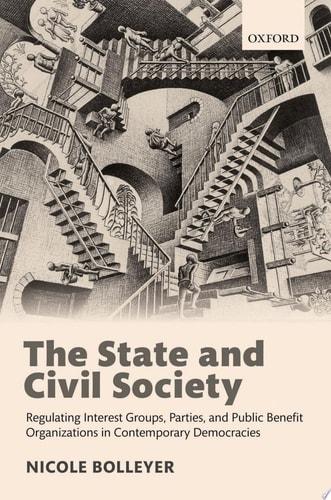
The State and Civil Society: Regulating Interest Groups, Parties, and Public Benefit Organizations in Contemporary Democracies
0
0
As an Amazon Associate and affiliate partner, Menrva Books earns from qualifying purchases. Learn more
Author Description
State regulation of civil society is expanding yet widely contested, often portrayed as illegitimate intrusion. Despite ongoing debates about the nature of state-voluntary relations in various disciplines, we know surprisingly little about why long-lived democracies adopt more or less constraining legal approaches in this sphere, in which state intervention is generally considered contentious.Drawing on insights from political science, sociology, comparative law as well as public administration research, this book addresses this important question, conceptually, theoretically, and empirically. It addresses the conceptual and methodological challenges related to developing systematic, comparative insights into the nature of complex legal environments affecting voluntary membership organizations, when simultaneously covering a wide range of democracies and the regulation applicable to different types of voluntary organizations. Proposing the analytical tools to tackle those challenges, it studies in-depth the intertwining and overlapping legal environments of political parties, interest groups, and public benefit organizations across 19 long-lived democracies. After presenting an innovative interdisciplinary theoretical framework theorizing democratic states' legal disposition towards, or their disinclination against, regulating voluntary membership organizations in a constraining or permissive fashion, this framework is empirically tested. Applying Qualitative Comparative Analysis (QCA), the comparative analysis identifies three main 'paths' accounting for the relative constraints in the legal environments democracies have created for organized civil society, defined by different configurations of political systems' democratic history, their legal family, and voluntary sector traditions. Providing the foundation for a mixed-methods design, three ideal-typical representatives of each path - Sweden, the UK, and France - are selected for the in-depth study of these lega
Menrva's Summary
THE THESIS
This book investigates why long-lived democracies adopt varying degrees of legal constraint when regulating voluntary membership organizations. Nicole Bolleyer, an expert in comparative politics and civil society, synthesizes insights from political science, sociology, and law to examine the tension between state intervention and voluntary sector autonomy. The work establishes an interdisciplinary theoretical framework to explain why some states favor permissive legal environments while others implement more restrictive regulatory regimes.
THE SCOPE MAP
What You Will Find
- A comparative analysis of 19 long-lived democracies and their legal treatment of political parties, interest groups, and public benefit organizations.
- An innovative interdisciplinary theoretical framework for analyzing state disposition toward civil society regulation.
- Application of Qualitative Comparative Analysis (QCA) to identify three distinct paths of regulatory development.
- In-depth case studies of Sweden, the UK, and France as ideal-typical representatives of different regulatory configurations.
THE AUTHORITY PERSPECTIVE
Experts recognize this work as a significant contribution to the comparative study of state-voluntary relations due to its rigorous methodological design. Scholars frequently highlight the book's utility in providing a systematic, mixed-methods approach to understanding complex legal environments across diverse democratic systems.
Page Count:
384
Publication Date:
2019-01-02
Publisher:
Oxford University Press
ISBN-10:
0198758588
ISBN-13:
9780198758587
Law
Sociology
Public Administration
Civil society
Comparative Politics
Democracy
State The
Community Tags
Similar Books






Reader Comments
Share Your Thoughts
No comments yet. Be the first to share your thoughts!