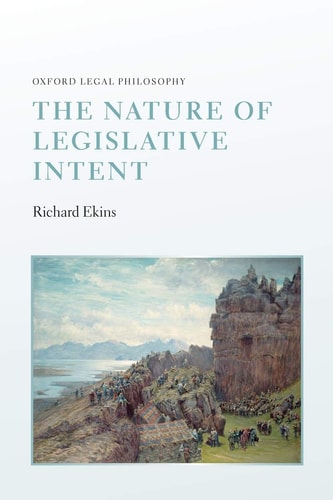
The Nature of Legislative Intent
0
0
As an Amazon Associate and affiliate partner, Menrva Books earns from qualifying purchases. Learn more
Author Description
Are legislatures able to form and act on intentions? The question matters because the interpretation of statutes is often thought to centre on the intention of the legislature and because the way in which the legislature acts is relevant to the authority it does or should enjoy. Many scholars argue that legislative intent is a fiction: the legislative assembly is a large, diverse group rather than a single person and it seems a mystery how the intentions of the individual legislators might somehow add up to a coherent group intention.This book argues that in enacting a statute the well-formed legislature forms and acts on a detailed intention, which is the legislative intent. The foundation of the argument is an analysis of how the members of purposive groups act together by way of common plans, sometimes forming complex group agents. The book extends this analysis to the legislature, considering what it is to legislate and how members of the assembly cooperate to legislate. The book argues that to legislate is to choose to change the law for some reason: the well-formed legislature has the capacity to consider what should be done and to act to that end. This argument is supported by reflection on the centrality of intention to the nature of language use. The book then explains in detail how members of the assembly form and act on joint intentions, which do not reduce to the intentions of each member, before outlining some implications of this account for the practice of statutory interpretation.Developing a robust account of the nature and importance of legislative intention, the book represents a significant contribution to the literature on deliberative democracy that will be of interest to all those thinking about legal interpretation and constitutional theory.
Menrva's Summary
THE THESIS
This book investigates whether a legislative body can possess and act upon a coherent, singular intention when enacting statutes. Richard Ekins, a scholar of legal philosophy, challenges the prevailing skepticism that views legislative intent as a mere fiction. By applying theories of group agency and common plans, Ekins argues that a well-formed legislature functions as a complex agent capable of forming detailed intentions that guide the creation of law.
THE SCOPE MAP
What You Will Find
- Analysis of group agency and the mechanics of common plans in purposive groups.
- Examination of the relationship between legislative action and the nature of language use.
- Theoretical framework for how individual legislator intentions coalesce into a unified group intent.
- Implications for the practice of statutory interpretation and deliberative democracy.
THE AUTHORITY PERSPECTIVE
Legal scholars and philosophers recognize this work as a rigorous defense of intentionalism within statutory interpretation. Experts frequently highlight the book's dense philosophical argumentation as a foundational text for those studying the intersection of constitutional theory and legislative process.
Page Count:
320
Publication Date:
2016-04-11
Publisher:
Oxford University Press
ISBN-10:
0198766203
ISBN-13:
9780198766209
Philosophy
Law
Constitutional Law
Legal Theory
Interpretation and construction
Community Tags
Other Editions(4)
Similar Books









Reader Comments
Share Your Thoughts
No comments yet. Be the first to share your thoughts!