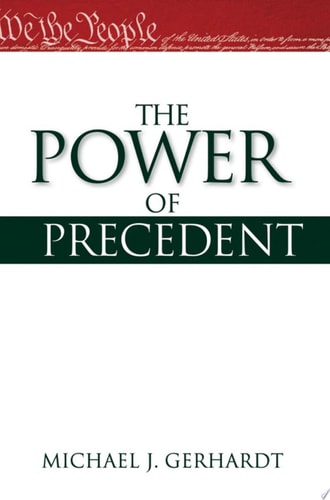
The Power of Precedent
0
0
As an Amazon Associate and affiliate partner, Menrva Books earns from qualifying purchases. Learn more
Author Description
The Role That Precedent Plays In Constitutional Decision Making Is A Perennially Divisive Subject Among Scholars Of Law And American Politics. The Debate Rages Over Both Empirical And Normative Aspects Of The Issue: To What Extent Are The Supreme Court, Congress, And The Executive Branch Constrained By Precedent? To What Extent Should They Be? Taking Up A Topic Long Overdue For Comprehensive Treatment, Michael Gerhardt Connects The Vast Social Science Data And Legal Scholarship To Provide The Most Wide-ranging Assessment Of Precedent In Several Decades. Updated To Reflect Recent Legal Cases, The Power Of Precedent Clearly Outlines The Major Issues In The Continuing Debates On The Significance Of Precedent And Evenly Considers All Sides. For The Supreme Court, Precedents Take Many Forms, Including Not Only The Court's Past Opinions, But Also Norms, Historical Practices, And Traditions That The Justices Have Deliberately Chosen To Follow. In These Forms, Precedent Exerts More Force Than Is Commonly Acknowledged. This Force Is Encapsulated In The Implementation And Recognition Of What Gerhardt Calls The Golden Rule Of Precedent, A Major Dynamic In Constitutional Law. The Rule Calls Upon Justices And Other Public Authorities To Recognize That Since They Expect Others To Respect Their Own Precedents, They Must Provide The Same Respect To Others' Precedents. Gerhardt's Extensive Exploration Of Precedent Leads Him To Formulate A More Expansive Definition Of It, One That Encompasses Not Only The Prior Constitutional Decisions Of Courts But Also The Constitutional Judgments Of Other Public Authorities. Gerhardt Concludes His Study By Looking At What The Future Holds For The Concept, As He Examines The Decisions And Attitudes Toward Precedent Exhibited By The Shift From The Rehnquist To The Roberts Court. Authoritative And Incisive, Gerhardt Presents An In-depth Look At This Central Yet Understudied Phenomenon At The Core Of All Constitutional Conflicts And One Of Undeniable
Menrva's Summary
THE THESIS
This book investigates the extent to which precedent constrains the Supreme Court, Congress, and the Executive Branch in American constitutional decision-making. Michael J. Gerhardt, a noted scholar of constitutional law, synthesizes extensive social science data and legal scholarship to evaluate the role of historical practice and judicial norms. He argues for an expansive definition of precedent that includes not only past court opinions but also the constitutional judgments of other public authorities. By introducing the 'Golden Rule of Precedent,' Gerhardt provides a framework for understanding how public officials balance their own authority with the respect owed to prior decisions.
THE SCOPE MAP
What You Will Find
- An analysis of the shift in judicial attitudes from the Rehnquist Court to the Roberts Court.
- The introduction and application of the 'Golden Rule of Precedent' as a governing dynamic in constitutional law.
- A comprehensive review of legal scholarship and social science data regarding judicial constraint.
- An examination of how norms, historical practices, and traditions function as binding precedents for the Supreme Court.
THE AUTHORITY PERSPECTIVE
Legal scholars and political scientists identify this work as a foundational text for understanding the mechanics of constitutional interpretation. Readers frequently note the academic density of the prose, which provides a rigorous and balanced assessment of a complex legal phenomenon.
Page Count:
352
Publication Date:
2008-01-01
Publisher:
Ebsco Publishing
ISBN-10:
0198034261
ISBN-13:
9780198034261
Politics
Legal History
Interpretation and construction
Stare Decisis
Law
American Government
United States
Constitutional Law
Präzedenzfall
Community Tags
Other Editions(3)

Similar Books


Reader Comments
Share Your Thoughts
No comments yet. Be the first to share your thoughts!