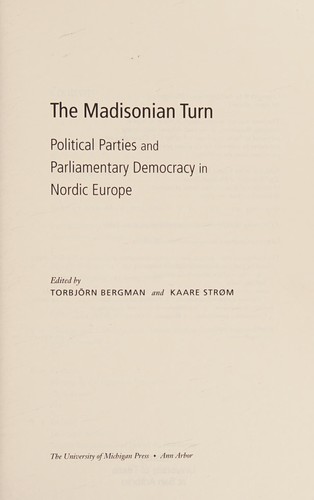
The Madisonian Turn
0
0
As an Amazon Associate and affiliate partner, Menrva Books earns from qualifying purchases. Learn more
Author Description
Parliamentary democracy is the most common regime type in the contemporary political world, but the quality of governance depends on effective parliamentary oversight and strong political parties. Denmark, Finland, Iceland, Norway, and Sweden have traditionally been strongholds of parliamentary democracy. In recent years, however, critics have suggested that new challenges such as weakened popular attachment, the advent of cartel parties, the judicialization of politics, and European integration have threatened the institutions of parliamentary democracy in the Nordic region. This volume examines these claims and their implications. The authors find that the Nordic states have moved away from their previous resemblance to a Westminster model toward a form of parliamentary democracy with more separation-of-powers features, a Madisonian model. These features are evident both in vertical power relations (e.g., relations with the European Union) and horizontal ones (e.g., increasingly independent courts and central banks). Yet these developments are far from uniform and demonstrate that there may be different responses to the political challenges faced by contemporary Western democracies. Torbjörn Bergman is Professor of Political Science at Umes University, Sweden. Kaare Strom is Professor of Political Science at the University of California, San Diego. --Book Jacket.
Menrva's Summary
THE THESIS
The quality of governance in parliamentary democracies hinges on effective oversight and robust political parties, yet recent decades have seen challenges to these institutions in the Nordic region. This volume investigates claims that weakened popular attachment, cartel parties, judicialization, and European integration threaten Nordic parliamentary democracy. The authors present evidence that these states are shifting from a Westminster model towards a more separation-of-powers, Madisonian model. This transformation is observable in both vertical power relations, particularly with the European Union, and horizontal ones, such as the growing independence of courts and central banks, though the extent of these changes varies across the region.
THE SCOPE MAP
- Analysis of the traditional strengths of parliamentary democracy in Denmark, Finland, Iceland, Norway, and Sweden.
- Examination of contemporary challenges: weakened popular attachment, cartel parties, judicialization of politics, and European integration.
- Evidence of a shift from the Westminster model towards a Madisonian model of parliamentary democracy.
- Exploration of vertical power relations, including the impact of the European Union.
- Analysis of horizontal power relations, focusing on the increasing independence of courts and central banks.
- Discussion of the unevenness of these developments across Nordic states.
- Implications of these changes for contemporary Western democracies.
THE AUTHORITY PERSPECTIVE
The book examines the evolving nature of parliamentary democracy in the Nordic countries, presenting a nuanced argument about a shift towards a Madisonian model characterized by greater separation of powers. The analysis is grounded in the authors' expertise in political science, drawing on comparative data to support their claims. The work is likely to be of interest to scholars and students of comparative politics, European studies, and democratic theory. It offers a detailed look at institutional changes and their potential consequences for governance.
Page Count:
428
Publication Date:
2011-01-01
ISBN-10:
0472117475
ISBN-13:
9780472117475
Non-Fiction
Art
History
Politics
Comparative Politics
Democracy
Community Tags
Similar Books