Productivity Puzzles Across Europe: Studies of Policy Reform
0
0
As an Amazon Associate and affiliate partner, Menrva Books earns from qualifying purchases. Learn more
Author Description
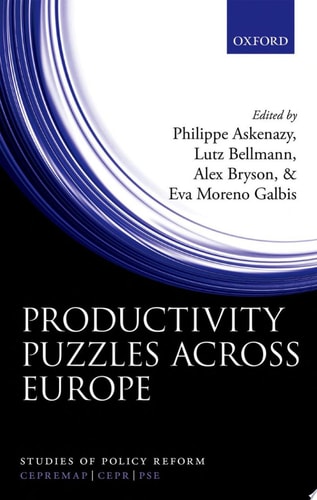
The 2008 financial crisis put an end to an era of sustained economic growth in Europe. The size of the shock differed across European countries and affected economies in different ways. Yet despite this heterogeneity, most European countries suffered a prolonged period of economic slowdown which raised concerns about the risk of a secular stagnation in Europe. This book focuses on labour productivity in Europe, one of the main drivers of growth and prosperity. Although productivity trends became the focus of policy interest in the immediate aftermath of the recession in the UK, 'productivity puzzles' received much less attention in the rest of Europe. These 'puzzles', which are apparent to greater or lesser extents in most European economies, centre on the marked decline in labour productivity growth which occurred with the on-set of recession. They are puzzles because, in neo-classical economics, firms respond to demand shocks by laying off workers, thus maintaining labour productivity and limiting growth in unit labour costs. Yet this didn't happen in this recession - at least, not to the same extent as in previous recessions, except in Spain.This book brings together contributions from leading European economists who analyse production models and macroeconomic policies, with specific focus on European countries that represent around 60% of the EU GDP. Chapters on France, Germany, the UK, and Spain provide new evidences at the firm/workplace level, and stress the role of transitory labour market mechanisms
Menrva's Summary
THE THESIS
This book investigates the persistent decline in labor productivity growth across European economies following the 2008 financial crisis. The authors, a team of prominent European economists, utilize firm-level data and macroeconomic analysis to challenge traditional neo-classical assumptions regarding how firms respond to demand shocks. By examining the divergence between expected labor market adjustments and actual outcomes, the text provides a comprehensive framework for understanding the mechanisms behind secular stagnation and productivity stagnation in the European Union.
THE SCOPE MAP
What You Will Find
- Comparative analysis of labor productivity trends in France, Germany, the UK, and Spain.
- Examination of firm-level and workplace-level production models.
- Assessment of transitory labor market mechanisms and their impact on unit labor costs.
- Evaluation of macroeconomic policy responses to the post-2008 economic slowdown.
THE AUTHORITY PERSPECTIVE
Experts identify this work as a significant contribution to the study of European labor markets, particularly for its focus on the heterogeneity of economic responses across different nations. The text is noted for its rigorous empirical approach, making it a valuable resource for researchers and policymakers interested in the nuances of post-recession productivity.
Page Count:
360
Publication Date:
2016-11-22
Publisher:
Oxford University Press
ISBN-10:
0198786166
ISBN-13:
9780198786160
Economics
Macroeconomics
Community Tags
Similar Books