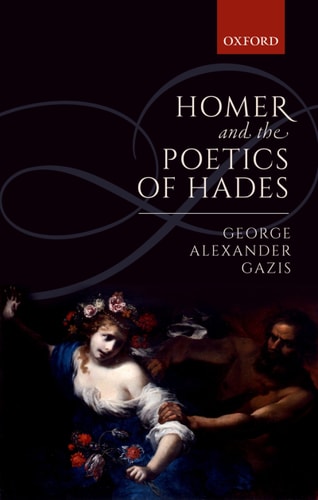
Homer and the Poetics of Hades
0
0
As an Amazon Associate and affiliate partner, Menrva Books earns from qualifying purchases. Learn more
Author Description
Homer and the Poetics of Hades offers a new and unique approach to the Iliad and, more particularly, the Odyssey through an exploration of the role and function of the Underworld as a poetic resource permitting an alternative perspective on the epic past. By portraying Hades as a realm where vision is not possible, Homer creates a unique poetic environment in which social constraints and divine prohibitions do not apply, resulting in a narrative which emulates that of the Muses but which at the same time is markedly distinct from it. In Hades experimentation with, and alteration of, important epic forms and values can be pursued with greater freedom, giving rise to a different kind of poetics: the 'poetics of Hades'.In the Iliad, Homer offers us a glimpse of how this alternative poetics works through the visit of Patroclus' shade in Achilles' dream. The recollection offered by the shade reveals an approach to its past in which regret, self-pity, and a lingering memory of intimate and emotional moments displace an objective tone and traditional exposition of heroic values. However, the potential of Hades for providing alternative means of commemorating the past is more fully explored in the 'Nekyia' of Odyssey 11: there, Odysseus' extraordinary ability to see the dead in Hades allows him to meet and interview the shades of heroines and heroes of the epic past, while the absolute confinement of Hades allows the shades to recount their stories from their own personal points of view. The poetic implications are significant, since by visiting Hades and listening to the stories of the shades Odysseus, and Homer with him, gain access to a tradition in which epic values associated with gender roles and even divine law are suspended in favour of a more immediate and personally inflected approach to the epic past. As readers, this alternative poetics offers us more than just a revised framework within which to navigate the Iliad and the Odyssey, inviting as it does a more nua
Menrva's Summary
THE THESIS
This work investigates how the Underworld functions as a distinct poetic resource within the Homeric epics, allowing for an alternative perspective on the heroic past. George Alexander Gazis, a scholar of classical literature, utilizes a close reading of the Iliad and the Odyssey to argue that Hades serves as a space where traditional epic constraints are suspended. By analyzing the narrative shifts that occur when characters interact with the dead, the author demonstrates how Homer employs the Underworld to experiment with memory, gender roles, and divine law.
THE SCOPE MAP
What You Will Find
- Analysis of the 'Nekyia' in Odyssey 11 and the dream sequence in the Iliad.
- A theoretical framework defining the 'poetics of Hades' as a departure from traditional epic exposition.
- Examination of how the absence of vision in the Underworld alters narrative authority.
- Comparative study of heroic values versus personal, subjective recollection.
THE AUTHORITY PERSPECTIVE
Scholars recognize this text as a specialized contribution to Homeric studies that challenges traditional interpretations of epic narrative structure. Readers frequently note the academic density of the prose, which is intended for advanced students and researchers of classical philology.
Page Count:
272
Publication Date:
2018-05-29
Publisher:
Oxford University Press
ISBN-10:
019878726X
ISBN-13:
9780198787266
Ancient Greek
English
English & College Success
Greek poetry
Literary Criticism
Criticism history
Epic Poetry
Homer
Community Tags
Other Editions(3)
Similar Books







Reader Comments
Share Your Thoughts
No comments yet. Be the first to share your thoughts!