Playing with Fire: Deepened Financial Integration and Changing Vulnerabilities of the Global South
0
0
As an Amazon Associate and affiliate partner, Menrva Books earns from qualifying purchases. Learn more
Author Description
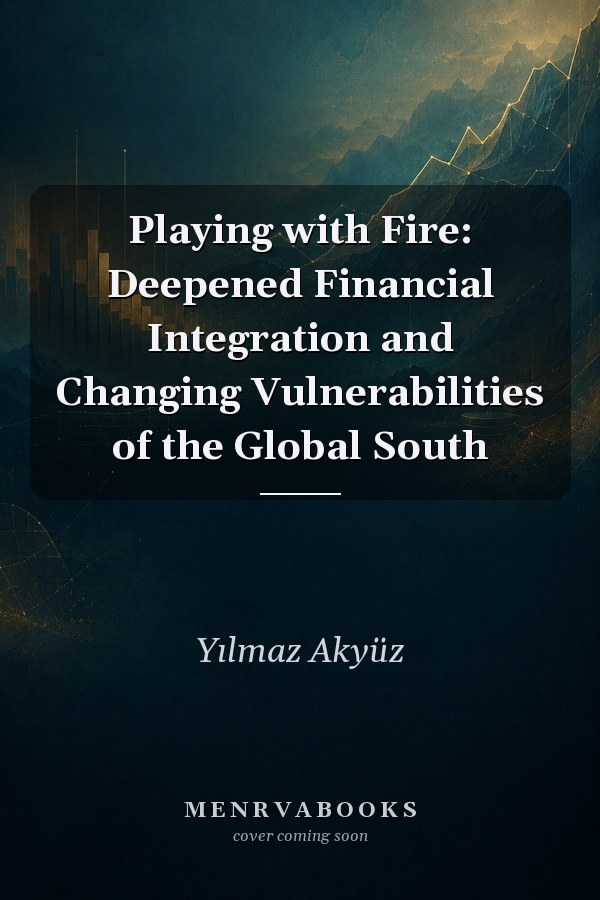
Starting in the early 1990s many emerging and developing economies (EDEs) liberalized their capital accounts, allowing greater freedom for international lenders and investors to enter their markets as well as for their residents to borrow and invest in international financial markets. Despite recurrent crises, liberalization has continued and in fact accelerated in the new millennium. Integration has been greatly facilitated by progressively looser monetary policy in the United States, notably the policies that culminated in debt crises in the United States and Europe and the ultra-easy monetary policy adopted in response. Not only have their traditional cross-border linkages been deepened and external balance sheets expanded rapidly, but also foreign presence in their domestic financial markets and the presence of their nationals in foreign markets have reached unprecedented levels. As a result new channels have emerged for the transmission of financial shocks from global boom-bust cycles. Almost all EDEs are now vulnerable irrespective of their balance-of-payments, external debt, net foreign assets and international reserve positions although these play an important role in the way such shocks could impinge on them. This is a matter for concern since the multilateral system still lacks mechanisms for orderly resolution of financial crises with international dimensions.Playing with Fire provides an empirical account of deeper integration of EDEs into the global financial system and discusses its implications for stability and growth, focusing on the role of policies in the new millennium in both EDEs and the United States and Europe.
Menrva's Summary
THE THESIS
This book investigates how the liberalization of capital accounts in emerging and developing economies (EDEs) has fundamentally altered their vulnerability to global financial shocks. Author Yılmaz Akyüz, a noted expert in international development and trade, utilizes empirical data to analyze the shift in financial integration since the 1990s. He argues that the expansion of external balance sheets and increased foreign presence in domestic markets have created new, volatile channels for transmission of boom-bust cycles, leaving these nations susceptible regardless of their traditional reserve positions.
THE SCOPE MAP
What You Will Find
- Analysis of capital account liberalization trends in emerging and developing economies since the 1990s.
- Examination of the impact of ultra-easy monetary policies in the United States and Europe on global financial stability.
- Empirical assessment of how deepened financial integration creates new transmission channels for global economic shocks.
- Evaluation of the current multilateral system's inability to provide mechanisms for the orderly resolution of international financial crises.
THE AUTHORITY PERSPECTIVE
Experts recognize this work as a critical contribution to the study of international political economy and the risks inherent in modern financial globalization. Readers frequently note the technical density of the prose, which provides a rigorous framework for understanding the systemic vulnerabilities of the Global South.
Page Count:
288
Publication Date:
2017-09-06
Publisher:
Oxford University Press
ISBN-10:
0198797176
ISBN-13:
9780198797173
Economics
Developing Countries
International Development
Globalization
Financial Services Industry
Finance